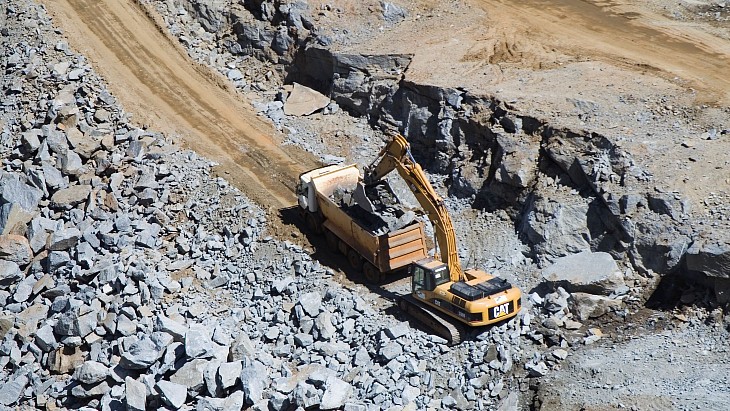
State-owned Indústrias Nucleares do Brasil (INB) launched the Pró-Urânio programme in 2024 "with the aim of expanding and accelerating the exploration of new deposits, and which will involve BNDES (Brazilian National Bank for Economic and Social Development) in developing the model for partnerships with mining companies".
According to INB: "The programme will allow Brazil to increase its ore production sustainably, guaranteeing the supply for the Angra 1 and Angra 2 nuclear power plants and creating conditions to export the surplus. The expansion will make it possible to reduce external dependencies through partnerships in other strategic stages of the nuclear fuel cycle."
The national investment bank's role involves two main phases: covering the diagnosis and structuring of the process for making a partnership offer in mining areas; and the preparation of the selection process for the partnership, which must occur in accordance with the model defined at the end of Phase 1.
There are five mining areas involved in the partnership offer: Amorinópolis, in the municipalities of Amorinópolis and Iporá; Espinharas, in the municipality of São José de Espinharas; Figueiras, in the municipality of Sapoema; Rio Preto, in the municipalities of Cavalcante, Colinas do Sul and Arraias; and Lagoa Real, in the municipality of Caetité.
Interested consulting firms are asked to provide their technical qualifications and estimated costings and suggestions on the Draft Technical Specifications to the Brazilian National Bank for Economic and Social Development by the end of 15 December.
Background
According to World Nuclear Association, following active exploration in the 1970s and 1980s, Brazil has reasonably assured resources of 210,000 tonnes of uranium. There has been little exploration since the mid-1980s - but in August 2024 Brazil's fuel cycle company Industrias Nucleares do Brasil announced it was to resume exploration for uranium.
The country's three main deposits are: Pocos de Caldas in Minas Gerais state, where a uranium mine closed in 1997; Lagoa Real or Caetité in Bahia state, which has been operating since 1999; and Itataia, now called Santa Quitéria, in Ceará state, where the production of uranium as a co-product with phosphate is planned.
Uranium has been mined in Brazil since 1982, but the only operating mine is INB's Lagoa Real/Caetité mine, with a capacity of 340 tU per year. The mine has known resources of 10,000 tU at 0.3%U.
INB commenced developing the adjacent Engenho mine in January 2017, a 200-300 tU per year open pit operation. Production was initially planned from October 2017, but did not commence.
In January 2020, the country's energy minister reported that investment in INB would allow it to produce 150 tU annually from Caetité, starting in 2020, and expanding to 360 tU per year by 2023. The Santa Quitéria Consortium - a partnership between INB and privately owned fertiliser producer Galvani - expects to produce 2,300 tons of uranium concentrate annually from the Itataia deposit.
In 2022, Brazil produced 43 tU. All mined uranium is used domestically, after conversion and most enrichment abroad. The country's uranium requirements are currently about 339 tU per year.


_29695_19459.jpg)
_98552.jpg)
_1_12560.jpg)
_22582.jpg)