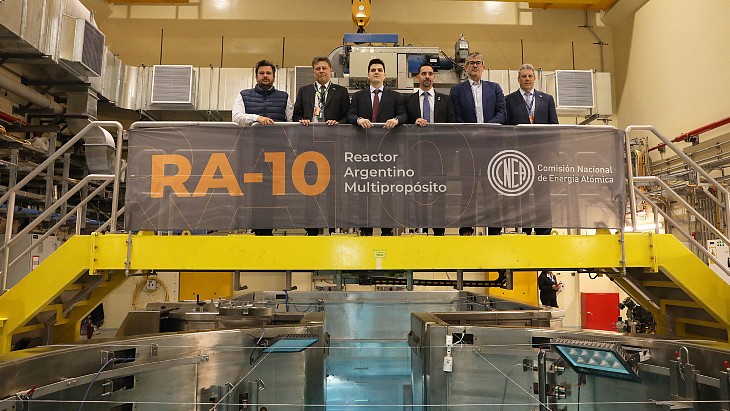
According to a presentation at the RA-10 site at the Ezeiza Atomic Centre, there is currently a team of 530 people completing the final work and carrying out the necessary tests of systems ahead of commissioning and operation of the reactor.
The RA-10 is a 30-megawatt open-pool multipurpose nuclear research reactor and will make products and services for the health, science, technology and industry sectors. For instance, it is expected to produce about 20% of the total global demand for molybdenum-99, a key radioisotope used in nuclear medicine.
The presentation was led by Secretary of Nuclear Affairs, Federico Ramos Napoli, and the President of the National Atomic Energy Commission (CNEA) Martín Porro. They said the aim was to begin commissioning before the end of this year, once a licence is obtained from the Nuclear Regulatory Authority (ARN).
According to the CNEA report of the event, the secretary of nuclear affairs has "defined a model that will allow the incorporation of private capital to finance the development and construction” of the associated production plant, "as well as the production and commercial activities associated with the reactor. The national government will maintain strategic leadership … while the regulation and oversight of the activity will remain under the purview of the ARN".
It adds that the "planned capacity for the RA-10 exceeds projected domestic demand. This will strengthen the supply of the Argentine healthcare system with domestically produced equipment and allow for the export of surpluses, with the potential to generate foreign exchange and highly skilled jobs in an international market with few suppliers and high technological barriers".
The RA-10 project was approved by the then government and officially started by CNEA in June 2010. Argentina's Nuclear Regulatory Authority granted a construction licence for RA-10 in November 2014. The civil works for the reactor began in 2016. Nuclear technology firm Invap is involved in the design and construction of the reactor facility and related installations, playing the role of main contractor. It is currently said to be 96% completed.
It will replace the RA-3 reactor on the same site, a 10 MWt pool-type reactor that began operations in 1967. The RA-10 will also have associated facilities such as the Argentine Neutron Beam Laboratory and the Laboratory for the Study of Irradiated Materials. In addition to producing radioisotopes, it will also enable the production of doped silicon for industrial applications as well as facilitating new research in a range of areas and training.


_55605.jpg)

_18654.jpg)