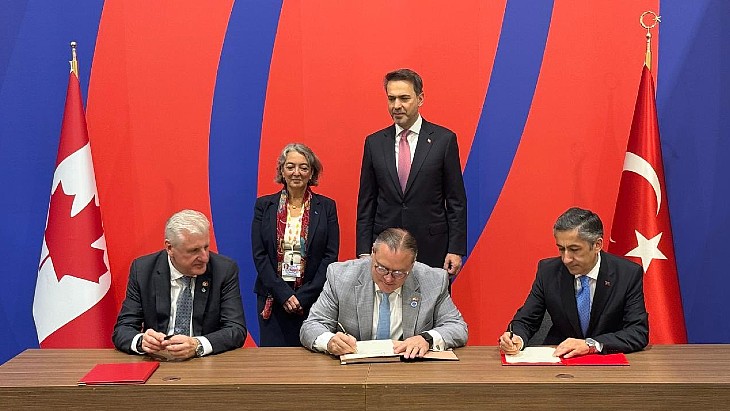
The agreement, signed at COP31 in Turkey (see picture above), will see the Canadian engineering giant undertake feasibility and Front-End Engineering Design studies for the expansion of Turkey's nuclear programme.
It will focus on a potential multi-unit deployment, evaluating the proposed site's characteristics, infrastructure requirements, environmental considerations, broader project development needs as well as economic and funding options. It will also look at how local supply chains can be developed and long-term economic value maximised in Turkey.
Ian Edwards, President and CEO of AtkinsRéalis, said: "This milestone reflects the federal government's ambitions to strengthen international partnerships and the global reach of Canadian nuclear expertise, with Candu nuclear technology at the centre of that strategy."
The feasibility study is due to be completed in May, Edwards said, adding, "we will home in on a site-specific proposal with a costing and a financial framework around it, with partners and with a full proposal … we bring the reactor technology, we bring the innovation, but importantly, we probably add about 35% to 40% of the overall capex, but the rest of it will come from Turkey".
Joe St Julian, President, Nuclear, AtkinsRéalis, said the agreement "creates the momentum needed for projects to get to a final investment decision" and stressed the bilateral benefits of such a project, saying that the Candu technology offers greater potential localisation than other technologies.
"What that means for Turkey is you can build a nuclear power station in Turkey with Turkish manufacturing, Turkish labour, and you can create a durable, sustainable nuclear industry that's self-reliant … and those are good-paying jobs," he said.
"The benefit to Canada is, even though you're building this plant in Turkey, there are certain components that will still be manufactured in Canada, and it's their technology. So Canada has a benefit at home in their GDP, maybe to a far less extent than other OEMs (original equipment manufacturers), but there is a benefit, both economic, and also a geopolitical benefit as well. So it's a win-win."
Background
Turkey is currently in the process of constructing its first nuclear power plant, Akkuyu, in the southern Mersin province. Russia's state nuclear corporation Rosatom is building four VVER-1200 reactors, under a so-called BOO (build-own-operate) model. According to the terms of the 2010 Intergovernmental Agreement between the Russian Federation and the Republic of Turkey, the aim was for the commissioning of the first power unit of the nuclear power plant to take place within seven years from receipt of all permits for the construction of the unit.
The licence for the construction of the first unit was issued in 2018, with construction work beginning that year. Nuclear fuel was delivered to the site in April 2023. The aim has been for unit 1 to begin supplying Turkey's energy system by the end of 2026. First concrete was poured for unit 4 in July 2022. When the 4,800 MWe plant is completed, it is expected to meet about 10% of Turkey's electricity needs.
Turkey has plans for a second nuclear power plant, at Sinop, and has also been in talks with China about plans for a third plant, in the Thrace region in the country's north-west. The country is also developing plans for small modular reactors (SMRs), with the aim of adding 5 GWe of capacity by 2050 - which would mean the equivalent of at least 16 individual SMRs.
Candu - for Canada Deuterium Uranium - technology is a Canadian reactor design that uses heavy water (deuterium oxide) as a moderator and coolant, and is fuelled using natural uranium (as opposed to enriched uranium). The first prototype unit - with a gross capacity of only 25 MWe - was connected to the grid at Rolphton, Ontario in 1962. Since then, some 34 units have been built around the world, including all 17 of the reactors currently operating in Canada, building up nearly 1,000 reactor-years of experience. It has demonstrated strong operational and safety performance internationally, in Canada, Romania, Argentina, South Korea, and China.
Canadian-headquartered global engineering giant AtkinsRéalis is the original equipment manufacturer and exclusive licence holder of Candu technology: the intellectual property belongs to the Canadian government, and is held on its behalf by Crown corporation Atomic Energy of Canada Ltd.