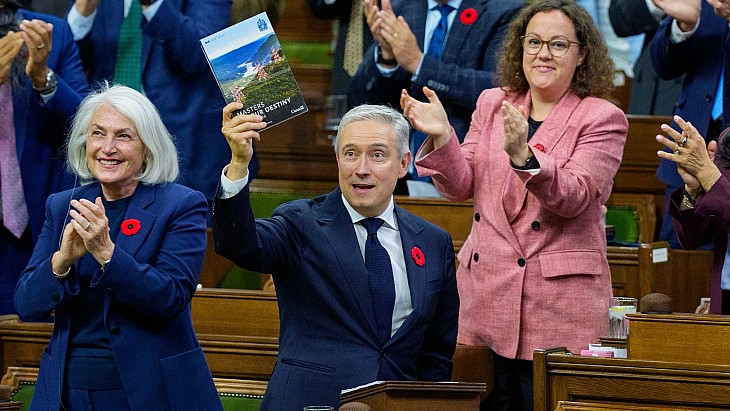
Minister of Finance François-Philippe Champagne described the 2026 Budget, titled Masters of our destiny, as an ambitious plan building on the progress from 2025's budget which has already seen major projects move forward, with 28 "nation-building initiatives" referred to the Major Projects Office, set up by the federal government to help fast-track major projects. (Ontario Power Generation's Darlington New Nuclear project was one of the first to be referred for consideration.)
The budget, published on 5 November, sets out plans for investments of more than CAD50 billion (USD35.4 billion) to support the goal of doubling electricity grid capacity by 2050 to meet growing demand, while accelerating electrification, under the National Electricity Strategy, and CAD518.5 million to strengthen domestic supply chains and Canada's position as a "global energy superpower" under the Nuclear Energy Strategy.
The Nuclear Energy Strategy was presented by the government in June, setting out a plan to grow the sector by unlocking investment, modernising regulation, strengthening Canadian research and development, and promoting Canadian nuclear expertise abroad.
"To implement key commitments under the strategy, Budget 2026 proposes to provide CAD518.5 million over five years, starting in 2027-28, and CAD18.1 million ongoing to advance Canada’s nuclear research, supply chains, workforce, and regulatory capacity," the Budget notes.
This includes: CAD261 million over five years, starting in 2027-28, and CAD4 million ongoing, to Natural Resources Canada to develop nuclear supply chains, support research and development, and advance research reactor capacity and readiness: CAD127 million over five years, starting in 2027-28; CAD131.1 million over five years, starting in 2027-28, to the Canadian Nuclear Safety Commission to prepare for new nuclear projects and become Canada's sole federal regulator for nuclear energy projects (CAD18.3 million of this would be cost-recovered); CAD14.4 million over five years, starting in 2027-28, and CAD3.1 million ongoing, to Global Affairs Canada, for nuclear export promotion and government-to-government engagement; and CAD3.3 million over five years, starting in 2027-28, to Health Canada to support the CNSC with expertise on the human health impacts of radiation exposure.
Investments to date under the Nuclear Energy Strategy have totalled CAD6.5 billion, including up to CAD2 billion from the Canada Growth Fund for the Darlington Nuclear Project, alongside support for Indigenous participation through the Indigenous Loan Guarantee Program; CAD970 million in low-interest financing from the Canada Infrastructure Bank; and access to the refundable Clean Electricity investment tax credit. Up to CAD3 billion of export financing has also been made available for the construction of two new CANDU reactors in Romania.
Recent milestones under the strategy highlighted in the Budget include the refurbishment of Ontario's operating nuclear power plants, Ontario and Saskatchewan "signalling the potential" to collectively install more than 17 gigawatts of new nuclear power by 2050; New Brunswick and Alberta "actively studying" the potential role of new nuclear; consideration of CANDU reactors for export "by a number of countries"; Cameco's signature of a CAD2.6 billion uranium deal with India; the start of construction of two new uranium mines; the assessment by the Department of National Defence of the potential for a "Canadian-controlled" heat and electricity providing microreactor; and moves to make the CNSC the sole responsible authority for conducting impact assessments for all applicable nuclear projects.
"The Nuclear Energy Strategy emphasises that nuclear energy is an essential element of a modern clean grid. It outlines the actions the federal government will take to leverage Canada's long-standing nuclear expertise and workforce, abundant uranium resources, and sovereign capabilities, in order to grow clean, baseload power, and create jobs and economic opportunities for Canadians at home and abroad," the Budget notes.
“Being masters of our destiny is about having the confidence to build on our strengths and shape our own future," Champagne said. "Canada has the resources, talent and ambition to succeed. Budget 2026 builds on those strengths by unlocking investment, building more at home, strengthening our energy and natural resource advantage, and helping Canadian businesses grow and compete on the world stage. That’s how we will create good jobs, make life more affordable, and build a stronger, more resilient and more united Canada for generations to come."