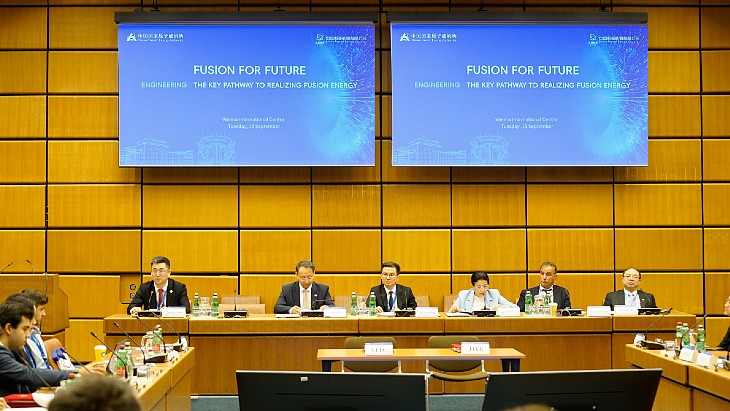
The event, hosted by China Fusion Energy Co, which is part of China National Nuclear Corporation (CNNC), began with the signing of cooperation agreements with the multinational ITER fusion project and between China's Southwestern Institute of Physics and the Thailand Institute of Nuclear Technology.
China Fusion Energy Co was established in 2025 and manages the Southwestern Institute of Physics (SWIP) which was established in 1965 and was China's earliest professional research institute dedicated to the development of controlled nuclear fusion energy and research on fusion plasma physics.
The institute, which has developed more than 20 fusion research devices of various magnetic configurations, "serves as a national team and core force in fusion reactor R&D under the 'three step' national nuclear energy development strategy". It has three campuses across two cities - Chengdu in Sichuan province and in Shanghai.
The event in Vienna was also told that the HL-3 device, the largest and highest-parameter tokamak in China, had since 2020 achieved "continuous breakthroughs" and in 2025 it achieved "dual hundred-million-degree" operation, with an ion temperature of 120 million degrees Celsius and an electron temperature of 160 million degrees Celsius.
The HL-3, which has had the status of an ITER satellite device since 2023, was opened for international cooperation in 2024 and since then - with a focus on high beta plasmas, advanced diverter physics and disruption physics - more than 80 international scientists have participated, with more than 260 proposals received and more than 100 papers published.
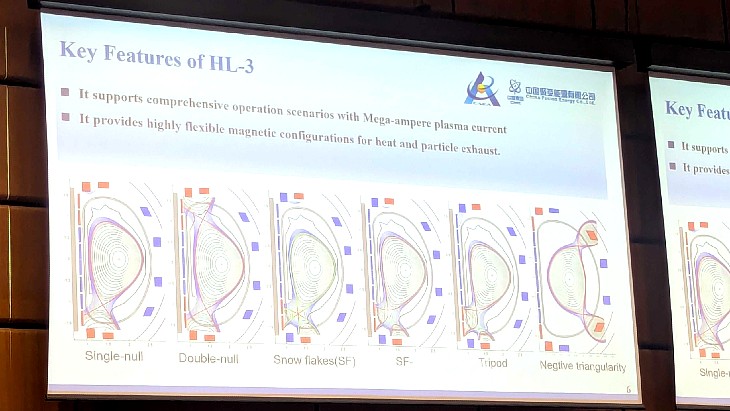
(Image: WNN picture of image in presentation)
The event was told that key progress includes: "Two sets of 120keV positive ion source neutral beam heating have been successfully developed and are now operational in the HL-3 experiment; each beam line has a maximum power of 7 MW, the highest in China and has independent intellectual property rights, reaching the international advanced level; the fusion device control system CODIS has been applied in multiple fusion devices; and a data-driven high-fidelity magnetic configuration evolution simulator has been developed, and plasma AI-controlled takeover within 400ms has been achieved."
The first nuclear fusion ISO standards released by SWIP are - from 2023 on 'hot helium leak testing method for high temperature pressure-bearing components' and last month for 'supersonic molecular beam injection fueling technology'.
Southwestern Institute of Physics said it has international cooperation agreements with 30 countries. The event was told there were now 60 members of the Controllable Nuclear Fusion Innovation Consortium, which was established in 2023, and which ncludes Thai and Kazakh representation.
The consortium's objective is "Engineering and commercialisation of fusion energy". Progress updates included on the Shanghai Fusion Science Research Centre, where land acquisition (of 147,160 square metres) has been completed, construction work has started, and completion is scheduled for 2030.
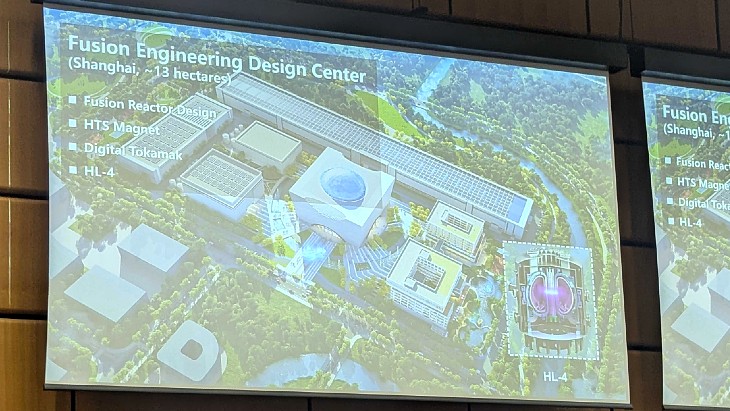
The Shanghai facility will be home to the proposed HL-4 device (Image: WNN photo image in presentation)
(Image: WNN picture of image in presentation)
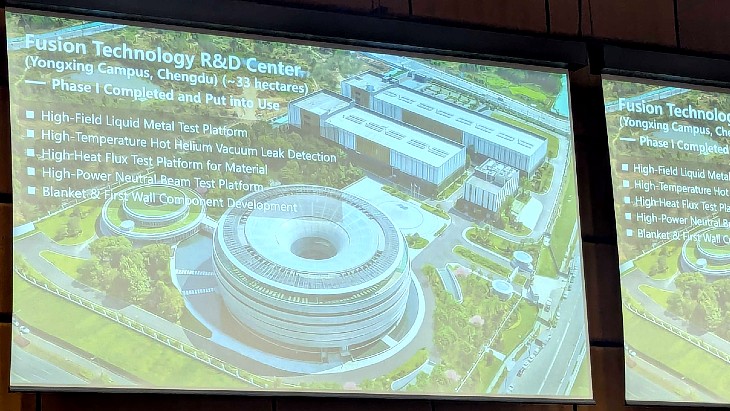
The Tianfu Fusion Technology R&D Centre Phase II has also completed land acquisition. with completion scheduled for 2030.
China Fusion Energy Co also leads the HTS Magnet Technology Innovation Consortium, with "the first 25 T JTS high-field magnet development and testing line scheduled to be completed by 2028 and prototype magnet development will be finished by 2030".
There are extensive facility upgrades under way at HL-3, the event heard, with plans to perform deuterium-tritium burning-plasma physics experiments in 2027. Construction was said to be in the final phase, with key equipment installation ongoing and a new plasma control centre already available.
Attendees were also told of four cooperation pathways available with the HL-3 team - namely joint experiments, joint projects, technical validation and training and workshops.
In terms of global cooperation, the meeting heard that nuclear fusion "has advanced from fundamental research to engineering demonstration and pre-commercial phases". But while scientific feasibility has been verified, "engineering bottlenecks remain the key challenge" and "existing international mechanisms focus on R&D, lack dedicated frameworks for fusion engineering innovation, industrial collaboration and standard-setting".
"Gaps in the engineering chain propagate costs and risks downstream, demanding systematic engineering collaboration. Confronted with unprecedented engineering challenges, accelerated breakthroughs can only be achieved by pooling global wisdom and strengths. The initiative targets breaking down barriers, promoting co-construction and shared benefits, and advancing the early commercialisation of fusion energy."
A Global Fusion Supply Chain Sharing Programme is proposed which "aims to break bottlenecks, cut costs and accelerate industrialisation, pursues joint procurement, unified standards, risk-sharing and technology collaboration and builds a safe, efficient and sustainable industrial ecosystem".
The tasks include creating a "universal engineering language for fusion engineering" and uniting "top global fusion experts to jointly develop a scientific, rigorous industry-standard system".
Global research institutions and enterprises were invited to participate with the message that "together we can build an open, collaborative ecosystem that delivers clean, sustainable energy for humanity's future".


_29695_19459.jpg)
_98552.jpg)
_1_12560.jpg)
_22582.jpg)


_84289_33276.jpg)