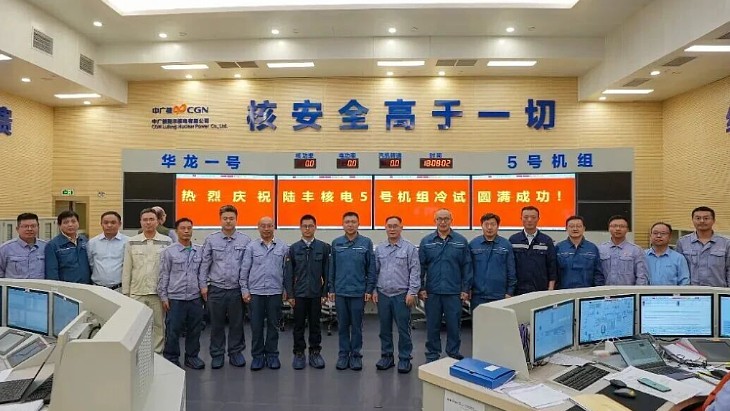
Cold testing is a key moment for a nuclear power unit as it moves from the installation phase to the commissioning phase.
Such tests are carried out to confirm whether components and systems important to safety are properly installed and ready to operate in a cold condition. The main purpose of cold functional tests is to verify the leak-tightness of the primary circuit and components - such as pressure vessels, pipelines and valves of both the nuclear and conventional islands - and to clean the main circulation pipes. The tests mark the first time the reactor systems are operated together with the auxiliary systems.
The cold test of unit 5 began on 17 April and lasted for 10 days. Lufeng Nuclear Power and China General Nuclear's Lufeng project department established a joint command with unified plans and unified goals and carried out the work in a "rigorous, cautious, meticulous and practical" way, CGN said.
Background
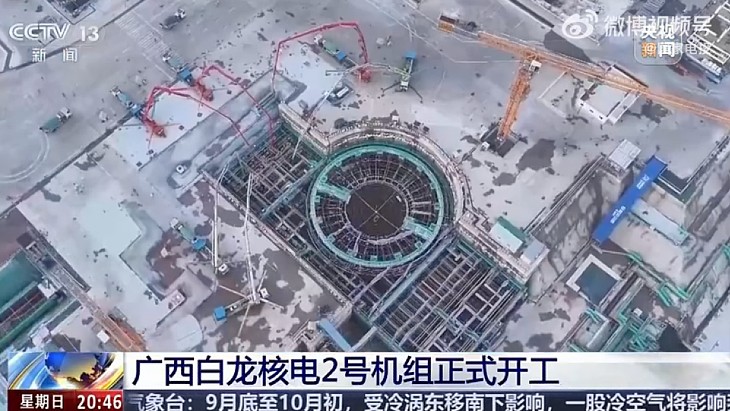
The Lufeng Nuclear Power Project is the first nuclear power project in eastern Guangdong Province. The proposed construction of four 1250 MWe CAP1000 reactors (units 1-4) at the Lufeng site was approved by China's National Development and Reform Commission in September 2014. However, the Lufeng units have not been built in the numerical order their names would appear to suggest. The construction of units 1 and 2 did not receive State Council approval until August 2024. The first safety-related concrete was poured for the nuclear island of unit 1 at the Lufeng plant on 24 February last year. Approval for units 3 and 4 is still pending.
In April 2022 the State Council approved construction of two Hualong One units at Lufeng as units 5 and 6. First concrete was poured for unit 5 on 8 September 2022 and that for unit 6 on 26 August 2023. Units 5 and 6 are expected to be connected to the grid in 2028 and 2029, respectively. The inner containment dome was installed at unit 5 in April 2024 and the outer containment dome in October 2025.
After the completion of the six pressurised water reactor units the plant will generate approximately 52 billion kilowatt-hours of electricity annually, which will mean a CO2 reduction equivalent to planting approximately 120,000 hectares of trees, according to CGN.



_42437.jpg)
_76412.jpg)