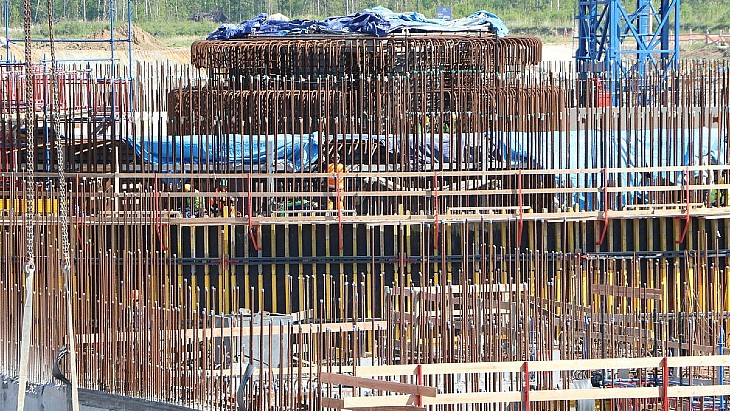
Over the next three months the first five tiers will be completed, up to nine metres in height. The following stages will see construction and installation work taking place simultaneously.
The reactor shaft will house the nuclear reactor and safety equipment at the unit, which is also known as Leningrad II-4.
Evgeny Milushkin, Deputy Director of the Leningrad NPP, said: "We will build the reactor shaft in stages. We will also gradually fill its interior with equipment. First, we will install the core catcher housing - an important passive safety system for the unit - in its designated location. The core catcher will be delivered to our site in early July, and its installation will take place later that month. In the following stages, we will install the remaining core catcher components, as well as the equipment for securing the reactor vessel. We will begin installation of the reactor itself in the second half of 2029."
Konstantin Khudyakov, from construction company Titan-2, said: "During the first stage of work on constructing the reactor shaft, specialists will need 175 tonnes of steel reinforcement and 612 cubic metres of concrete mix. Considering that the shaft will have to perform additional protective functions during the operation of the power unit, we will construct it from a special, heavy-duty concrete. This will ensure the structure's strength, durability, and radiation resistance."
Background
The Leningrad nuclear power plant is one of the largest in Russia, with an installed capacity of 4,400 MWe, and provides more than 55% of the electricity demand of St Petersburg and the Leningrad region, or 30% of all the electricity in northwest Russia.
Leningrad 1 shut down in 2018 after 45 years of operation. Leningrad 2, also a 1,000 MWe RBMK unit, started up in 1975 and was permanently shut down in November 2020. As the first two of the plant's four RBMK-1000 units shut down, new VVER-1200 units started up at the neighbouring Leningrad II plant. The 60-year service life of these fifth and sixth units (also known as Leningrad II-1 and Leningrad II-2) secures power supply until the 2080s, with the possibility of a further 20-year extension beyond that. Units 7 and 8 (also known as Leningrad II-3 and Leningrad II-4) will replace units 3 and 4 as they are shut in the coming years.
The pouring of the first concrete for unit 7 in March 2024 marked the start of the main phase of construction of the new power unit. First concrete was poured for the eighth unit in March 2025.


_29695_19459.jpg)
_98552.jpg)
_1_12560.jpg)
_22582.jpg)