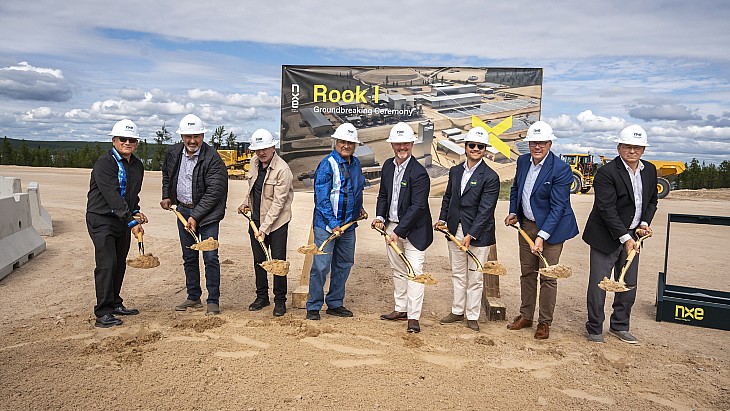
The groundbreaking ceremony comes after the company received the final regulatory approval for the project - described by NexGen as the largest development-stage uranium project in Canada - in March. The event brought together Indigenous leaders, federal and provincial representatives, investors, industry partners, employees, contractors, and community members, including Canada’s 22nd Prime Minister Stephen Harper, Saskatchewan Premier Scott Moe; Secretary of State for Rural Development and Member of Parliament Buckley Belanger, Métis Nation-Saskatchewan President Glen McCallum; and President of Métis Nation-Saskatchewan Local 39 Keith Shewchuk.
"Today, we transition from demonstrating what this project will be to delivering it - for the benefit of local communities, Saskatchewan, Canada, and the world," NexGen Founder and CEO Leigh Curyer said. Nuclear energy has become key to meeting the "unprecedented" electricity demand driven by artificial intelligence, advanced manufacturing, electrification, and energy security, "and with it, uranium has become one of the world’s most strategic resources," he added.
Rook I is located in the southern Athabasca Basin, about 155 km north of the town of La Loche. The project is situated on Treaty 8 territory, the Homeland of the Métis, and is within territories of the Denesųłiné, Cree, and Métis. The project has Benefit Agreements in place with all four Indigenous communities identified within its Local Priority Area, and is expected to support significant employment, procurement, and economic opportunities across northern Saskatchewan and beyond.
It is centred on the Arrow deposit, a high-grade uranium deposit discovered by the company in 2014. The deposit has a total Measured & Indicated resource estimate of 256.7 million pounds U3O8 (98,739 tU) including a probable reserve of 239.6 million pounds U3O8 with an average grade of 2.37% U3O8 (a uranium "reserve" is that part of a uranium resource that that is economically mineable at a given uranium price). A further 80.7 million pounds of estimated resources are in the Inferred category.
According to the company's 2021 feasibility study, the deposit - which lies between about 300 metres and 700 metres underground - will be accessed via two shafts (an 8 metre diameter Production Shaft and air intake, and a 5.5 metre diameter Exhaust Shaft which will provide a second egress). Production will be via conventional "longhole" mining. The estimated mill capacity is targeted at 1,300 tonnes of ore per day.
Some 300 people are currently working at the site. To date, more than 575,000 tonnes of aggregate have been crushed and stockpiled by a Clearwater River Dene Nation-partnered business, supporting up to 50 local jobs, NexGen said. Major earthworks and surface infrastructure are advancing, the initial 3,000-foot (914 metres) airstrip has been commissioned, and expanded site accommodations are complete and occupied. The full 5,840-foot airstrip is expected to be completed by December, with shaft development planned for 2027.
Stephen Harper, who served as the 22nd Prime Minister of Canada from 2006 to 2015, said Rook I, when completed, will deliver 20% of the world’s uranium supply with lasting economic benefit for the community and beyond. "This is an exciting, globally significant project for Saskatchewan and for Canada," he said on X.


_76412.jpg)
_38809.jpg)
_15774.jpg)