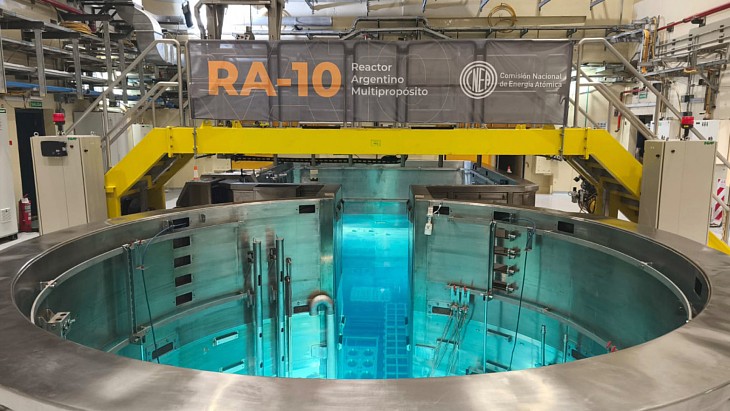
Argentina's National Atomic Energy Commission (CNEA) said the commissioning "allowed, for the first time, the observation of coolant circulation through the reactor's primary circuit. This milestone enables the comprehensive verification of the system's hydraulic performance and its compliance with design and safety parameters, an essential condition for proceeding with reactor commissioning".
Tests are to continue over the next two months to complete the functional validation of the reactor's primary cooling system.
Dummy fuel elements, supplied by the Fuel Element Manufacturing Plant for Research Reactors (ECRI), have allowed the configuration of the RA-10 core.
CNEA said: "This configuration allows for the necessary cold tests to be carried out to verify the performance of the cooling circuit under conditions representative of the operating configuration."
The RA-10 multipurpose reactor is a 30 MWt open pool type reactor. The project was approved by the government and officially started by CNEA in June 2010. Argentina's Nuclear Regulatory Authority granted a construction licence for RA-10 in November 2014. The civil works for the reactor began in 2016. Nuclear technology firm Invap is involved in the design and construction of the reactor facility and related installations, playing the role of main contractor.
The assembly of the RA-10 pool - which will house the core of the reactor - was completed in August 2018. The RA-10 will replace the RA-3 reactor on the same site, a 10 MWt pool-type reactor which began operations in 1967. The RA-10 will also have associated facilities such as the Argentine Neutron Beam Laboratory and the Laboratory for the Study of Irradiated Materials.
Argentina says the facility will guarantee self-sufficiency in radioisotopes for medical use and allow for exports to cover up to 20% of global demand. It will also enable the production of doped silicon for industrial applications as well as facilitating new research in a range of areas and training.


_98552.jpg)
_1_12560.jpg)
_22582.jpg)


_84289_33276.jpg)