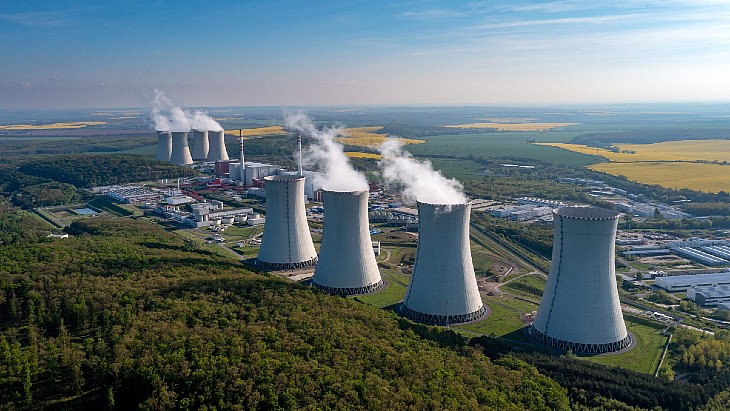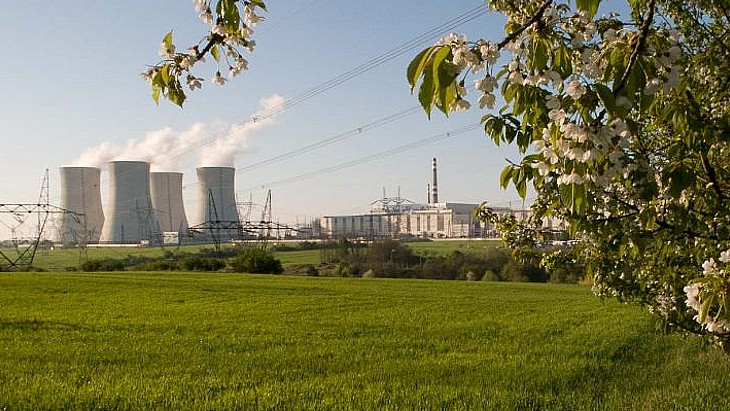
In April last year the European Commission (EC), which is the executive arm of the European Union (EU), approved the funding plan for a single new nuclear reactor at the Dukovany nuclear power plant site in the Czech Republic.
In July last year Korea Hydro & Nuclear Power (KHNP) was selected for the project, and in October this year the Czech Republic officially notified the EC it had expanded its plans to two new nuclear units, each with a capacity of 976 MWe.
What is the funding plan?
The EC says: "Czechia plans to support the construction of the new nuclear units through three measures: a low-interest repayable State loan of an initial amount currently estimated between EUR23 billion (USD27.1 billion) and EUR30 billion, which will cover the full construction costs; a two-way contract for difference with a proposed duration of 40 years to ensure stable revenues for the nuclear power plant; and a mechanism to protect EDU II in case of policy changes and adverse impacts, to address the risk arising from the longevity of exposure to policy changes."
EDU II is Elektrárna Dukovany II, a company set up to develop and operate the new nuclear units, which is owned by the Czech state (80%) and the Czech Republic's nuclear power plant operator ČEZ (20%).
The contract for difference effectively means that if electricity prices are below the agreed level, the nuclear project will receive a subsidy to make it up to the agreed price, and if electricity prices are above the agreed price, the nuclear project would pay money back to the government.
Is that different to the previously approved financing plan for one unit?
It sounds similar to the previously approved funding and the Czech government said it had "requested an extension of the already approved support (to the fifth unit) to the two-unit construction". When the two-year inquiry into the funding proposed for the one unit plan was completed in 2024 the EC said: "The Czech Republic plans to grant direct price support in the form of a power purchasing contract with a state-owned special purpose vehicle, ensuring stable revenues for the planned new nuclear unit at Dukovany for 40 years, with a subsidised state loan to cover a majority of construction costs as well as a protection mechanism against unforeseen events or policy changes."
One thing which has changed since the original approval is that the EC has updated its approved two-way contracts for difference (CfD) guidelines - set out in Article 19D on this page.
What issues has the EC now raised?
It says that, based on its preliminary assessment, "the project is necessary and considers that the aid facilitates the development of an economic activity" which will help decarbonise the energy sector and diversify the Czech energy mix.
But it has doubts about whether it is fully in line with EU State aid rules and wants to ensure that "no more aid than necessary is ultimately granted. In particular, the Commission has doubts on whether the proposed package achieves an appropriate balance between reducing risks to enable the investment and maintaining incentives for efficient behaviour, while avoiding excessive risk transfer to the State".
It also wants to look at the impact of the State aid measures on competition in the market "in particular, the Commission has concerns that several essential design elements of the CfD remain insufficiently specified, preventing the Commission from fully assessing whether the mechanism maintains efficient operational and maintenance incentives".
What happens now?
The EC says that it "will investigate further to determine whether its initial concerns are confirmed". It says that the opening of an in-depth inquiry "does not prejudge the outcome of the investigation" and it provides "Czechia and interested third parties the opportunity to submit comments". The previous inquiry took two years and included modifications to the Czech funding plan in its approved form.
What are the State aid rules?
European Union member states are free to determine their energy mix and the decision to use nuclear energy is one for each member state to take for themselves. State aid rules allow member states "to facilitate the development of certain economic activities under specific conditions. The support must be necessary and proportionate and must not adversely affect trading conditions to an extent contrary to the common interest".
What has the Czech government said?
The Czech Republic's Ministry of Industry and Trade says that the launch of the formal investigation is a "standard step and an important milestone" and it expects "approval to be obtained in approximately the first quarter of 2027". It says that the inquiry means "public consultation and negotiations between the Czech Republic and the Commission" can take place "regarding the doubts raised". It adds "this is how all previous notifications of public support for new nuclear sources in the EU were carried out as standard". The ministry adds that "in the meantime, the project is financed on commercial terms, so there is no risk of any delay".
What is the Czech Republic planning?
The Czech Republic currently gets about one-third of its electricity from the four VVER-440 units at Dukovany, which began operating between 1985 and 1987, and the two VVER-1000 units in operation at Temelín, which came into operation in 2000 and 2002. In July 2024 it selected KHNP for the planned project to build the two new units at Dukovany, with scheduled start dates of 2036 and 2037.
Further challenges to the decision?
The KHNP bid was said to be for around CZK200 billion (USD9.7 billion, EUR8.21 billion) per unit, if two were contracted. The Czech competition authority dismissed an EDF challenge to the decision in April this year and a subsequent court process concluded with a Czech Supreme Administrative Court decision which led to the contract being signed in June.
EDF's objections to the tender process included the belief that the KHNP offer price and the inclusion of a guarantee that the construction would not be delayed or become more expensive, would be "unfeasible without illegal state aid given the prices in the nuclear industry". EDF said that if their rival bidder had state support - from South Korea - it would breach European Union rules.
KHNP rejected EDF's case and in a statement to World Nuclear News in May it added that it "affirms that it has participated in the Czech new nuclear power plant project in strict compliance with all international regulations, including those of the European Union. We emphasise that we have not received any subsidies that could damage or distort fair competition in relation to the project".
Asked about the status of any investigation into foreign state aid, a European Commission spokesperson told World Nuclear News on Tuesday: "The Commission's assessment of a complaint by EDF under the Foreign Subsidies Regulation regarding the award of a tender to KNHP is ongoing. We do not comment on ongoing investigations."


_55605.jpg)