The flushing process is a key stage before cold and hot testing during the commissioning steps taken for a new nuclear power unit.
It involves the core pipelines and equipment, including the reactor coolant system, residual heat removal system and the safety systems. The flushing removes debris from inside pipelines, verifies flow capacity, and checks leak tightness and that everything has been installed correctly.
China National Nuclear Corporation said: "It is a crucial preliminary process for maintaining nuclear safety and ensuring the long-term stable operation of the unit.
"This flushing task has a tight schedule, frequent cross-operations of multiple systems, and stringent cleanliness acceptance standards. The Hainan Changjiang Nuclear Power Project Department, in collaboration with the owner, supervisor, general contractor, and other construction units, refined specialised construction plans and optimised on-site work procedures … preemptive hazard identification and mitigation were conducted to ensure the smooth, safe, and standardised implementation of flushing operations."
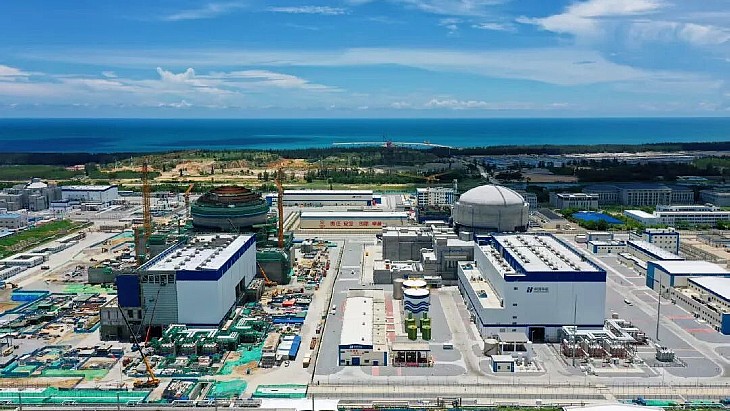
Two Hualong One reactors are being constructed in the second phase of the Changjiang plant. First concrete was poured for the base slab of unit 3's nuclear island in March 2021, with that of unit 4 being poured in the December of that year. Changjiang Phase II - units 3 and 4 - represents a total estimated investment of CNY40 billion (USD5.9 billion), according to China Huaneng, which holds a 51% share in the project. The outer dome was installed on unit 4 in April. The construction period is expected to be 60 months. Both units are scheduled to be fully operational in early 2027.
The Changjiang nuclear site is already home to two operating CNP-600 pressurised water reactors (PWRs) - Changjiang 1 and 2 - which entered commercial operation in 2015 and 2016, respectively. In 2021, CNNC also began construction of a demonstration ACP100 small modular reactor at the site. The multi-purpose 125 MWe PWR - also referred to as the Linglong One - is designed for electricity production, heating, steam production or seawater desalination. It is currently undergoing pre-commissioning tests.
The island province of Hainan is China's southernmost point. Energy policies published in 2019 by Hainan Province Development and Reform Commission specify that nuclear power will become the primary source of electricity for the island, which has a population of close to 10 million.


_76412.jpg)
_38809.jpg)
_15774.jpg)
_29250_15814.jpg)