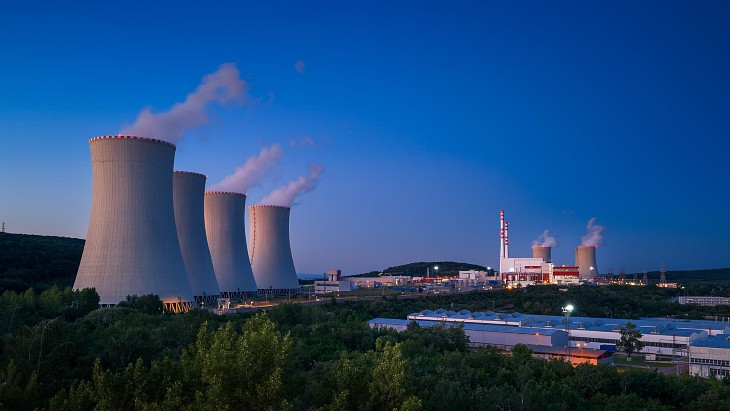
The Nuclear Regulatory Authority of the Slovak Republic issued notice of its commissioning permission for the new unit on 22 May, with the go-ahead confirmed on 24 June following a period to allow for any appeals against the decision.
The first fuel assembly was loaded into the reactor on 29 June at 15:45 local time.
The regulatory authority said that to secure the commissioning permission, "the investor had to demonstrate the readiness of the reactor unit for fuel loading and the start of active tests comprehensively in all assessed areas, from the completion of construction objects, through the completion of the assembly of technological systems, successful verification of project functions through a series of inactive system and integral tests, elimination of identified deficiencies and shortcomings, ensuring fire and radiation protection, environmental protection, to the readiness of personnel and operational documentation".
Once all the fuel is loaded, active reactor tests will begin, with each stage subject to the regulator's approval. The commissioning process will see the power increased in stages before a demonstration run for 144-hours at full power.
Construction of the first two VVER-440 units at the four-unit Mochovce plant started in 1982. Work began on units 3 and 4 in 1986, but stalled in 1992. The first two reactors were completed and came into operation in 1998 and 1999, respectively, with a project to complete units 3 and 4 beginning ten years later at an estimated cost of EUR6.7 billion (USD7.6 billion).
Mochovce 3 entered commercial operation in October 2023. Each of the units can provide 13% of Slovakia's electricity needs when operating at full capacity and when the 471 MW-capacity unit 4 is operating, nuclear will be providing the equivalent of 77.5% of Slovakia’s electricity consumption, the highest proportion for any country.
Branislav Strýček, Chairman and CEO of Slovenske elektrárne, said: "The fourth unit of Mochovce closes one of the key chapters in the development of the Slovak energy sector. It is the moment when the long-term efforts of thousands of people are transformed into a concrete value for the country - stable, low-emission and price-predictable electricity. Mochovce 4 is a reason for professional and human pride and at the same time proof that even smaller countries and nations can do great things."
Prime Minister Robert Fico said the country was a world leader in nuclear energy and can be "a role model not only for Europe, but also for the whole world", adding: "When a country has enough energy resources, it can feel safe. It's not just about guns, it's about whether the country has enough electricity without which you can produce nothing. You must have electricity."
Slovenské elektrárne's majority shareholder is Slovak Power Holding BV (SPH), which is owned by the Czech energy group Energetický a průmyslový. The second shareholder is the Slovak Republic, which has a 34% stake.
Slovakia currently has five nuclear reactors generating about half its electricity. As well as the Mochovce units, there are two at Bohunice, which went into commercial operation in 1984 and 1985, respectively. The Slovak government has plans for a new large unit at Bohunice, and has also been exploring the potential for small modular reactors in the country.


_51287.jpg)
_82983_12913.jpg)