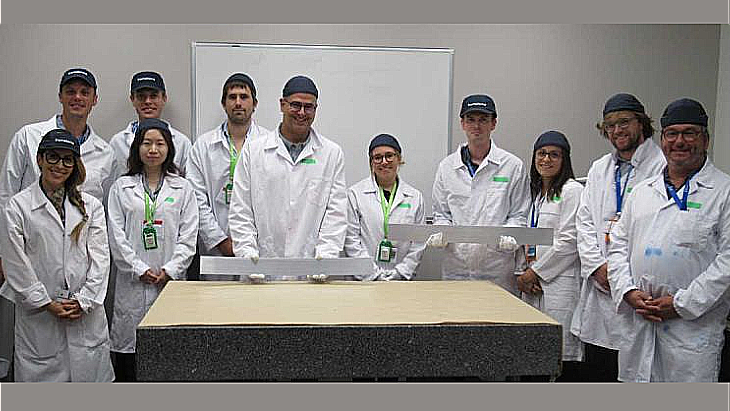
The fuel plates were fabricated at Framatome's CERCA manufacturing facility in Romans-sur-Isère, France, following on from a 2024 cooperation agreement between the French company and Technical University of Munich (TUM) to industrialise the production of uranium-molybdenum (U-Mo) monolithic fuel, which contains less than 20% uranium-235 but features the highest uranium fuel density ever realised in Europe.
The 20 MWt FRM II, operating since 2005, is one of the most effective and modern sources of high-flux neutrons in the world. The reactor is not used to generate electricity, but to provide a neutron source for industrial and scientific use, including the production of medical radioisotopes and the doping of high-purity silicon for the semiconductor industry. However, to generate its dense neutron flux the reactor currently uses highly enriched uranium (HEU) fuel which contains over 95% uranium-235 - and this is seen as a nuclear proliferation risk.
TUM has been collaborating with Framatome since 2019 on a programme to convert the reactor to run on fuel with lower uranium enrichment. In 2023, the company completed the development of the main component of the innovative monolithic U-Mo fuel, which, thanks to its high uranium density, can enable the reactor to perform as intended while using an enrichment of less than 20% uranium-235 (see Background section below).
The successful fabrication of the depleted uranium fuel plates marks an important milestone in the development of the future fuel design, Framatome said. Although not intended for use in the reactor, the plates are a major step towards the qualification of the fuel design. Using advanced manufacturing processes developed jointly with TUM, they demonstrate the maturity of the technologies required to establish a European industrial capability to produce advanced research reactor fuels.
"This achievement demonstrates Framatome's ability to transform an ambitious R&D programme into an industrial reality. The successful manufacturing of these first molybdenum-uranium monolithic fuel plates validates the technological choices made together with TUM and represents an important milestone toward the future qualification of the FRM II low-enriched fuel," Ralf Gathmann, vice president of CERCA at Framatome, said.
The production of the first two depleted uranium plates at their final dimensions shows the progress that is being made bringing TUM's FRM II conversion design together with CERCA's manufacturing expertise, FRM II Reactor Conversion Programme Director Christian Reiter said. "This result gives us a strong basis for the next development and qualification steps," he added.
The next phase of the programme will include the fabrication of a Generic Test Assembly with monolithic U-Mo fuel plates incorporating high-assay low-enriched uranium - also known as HALEU - with irradiation testing scheduled for 2028.
The conversion programme is funded by the Free State of Bavaria through TUM under a direct contract with Framatome and is also supported by the European Commission and Euratom through several projects, including the EUR12.8 million (USD13.3 million) EU-CONVERSION project which was launched in early 2025.
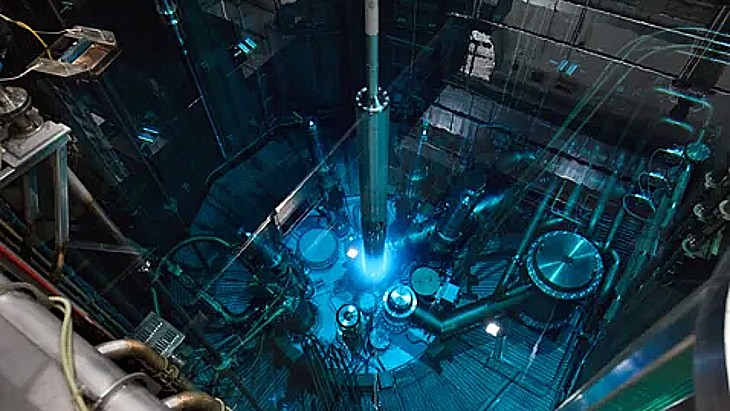
A fuel element in FBR-II (Image: Bernhard Ludewig/TUM)
Background
Research reactors are nuclear reactors used for research, development, education and training - they are generally not used for power generation, but rather to produce neutrons for research purposes as well as use in industry, medicine, agriculture and forensics, among others. FRM-II is one of the most powerful and advanced neutron sources in the world.
They may be small - compared to power-producing reactors - but the very different characteristics and functions of research reactors means they require fuel that is quite different from the ceramic uranium oxide pellets used in commercial nuclear power plants. Research reactors typically use fuel made of plates or cylinders of uranium-aluminium alloy with aluminium cladding. They also need fuel that is much more highly enriched in the fissile uranium-235 isotope than commercial nuclear fuel.
Most research reactors built up to the late 1970s were designed to use high-enriched uranium (HEU) fuel containing more than 20% of the fissile uranium-235 isotope - with some using enrichments as high as 93% U-235. But material containing such high enrichments presents a proliferation risk, should it fall into the wrong hands (uranium enriched to over 90% U-235 would be suitable for use in nuclear weapons). Since the late 1970s international efforts have focused on converting those research reactors using an HEU core to use fuel enriched to no more than 20% U-235 (known as high-assay low-enriched uranium, or HALEU), and many have now been converted to use new fuels with lower enrichments.
Specialised high-performance reactors - including FRM-II - have presented a different issue. To lower the enrichment of uranium in the fuel for these reactors - while still producing the neutron flux needed - the fissile uranium must be packed more densely in the fuel element. That means that the total content of uranium of any type (whether U-235 or non-fissile uranium-238) - has to be increased, without increasing the volume. Monolithic HALEU-Mo fuel, which is essentially pure metal with 10% Mo, instead of a dispersion of U-Mo in aluminium, is now being developed to enable these highly specialised reactors to use fuel with lower uranium enrichments.