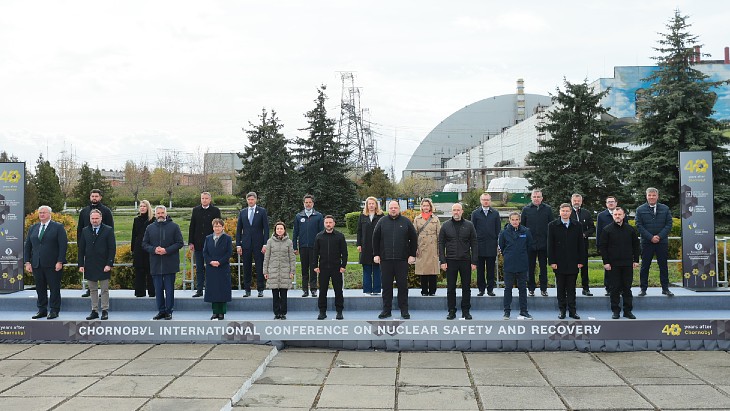
The memorial events and the International Conference on Nuclear Safety and Recovery were attended by people including Ukraine's President Volodymyr Zelenskyy, International Atomic Energy Agency Director General Rafael Mariano Grossi and European Bank for Reconstruction and Development (EBRD) President Odile Renaud-Basso.
As many as 600,000 people, known as liquidators, were involved in tackling the aftermath of the accident.
In his address to the conference, President Zelenskyy said: "Forty years ago, a terrible catastrophe occurred in Chornobyl (Chornobyl is the preferred Ukrainian spelling) - a catastrophe that had global significance and global consequences. Today, everything is already known about the causes of that catastrophe - the entire chain of decisions and mistakes that led to the accident and the explosion at the fourth power unit of the Chornobyl Nuclear Power Plant. People remember the heroism of our firefighters, who saved the plant and saved people. Today, I had the honour of awarding some of these truly heroic individuals who worked - or are working - here today. I want to thank you on behalf of all Ukrainians and all our guests. We thank you for your extremely difficult and high-level work, for your service to our state."
During the event, an agreement was signed with the EBRD for EUR30 million (USD35 million) of funding for the initial phase of restoration work on the giant arch-shaped New Safe Confinement shelter, which covers the initial shelter, which was hastily built in 1986 and encases the wreckage of unit 4.
Chernobyl at 40 - in-depth coverage
The accident, its impact and how it changed the world's nuclear energy industry
Chernobyl at 40: Wildlife and science in the exclusion zone
Chernobyl at 40: The decommissioning challenge
The New Safe Confinement, the world's largest man-made movable structure, was completed and moved into position in 2019, with a design life of 100 years. It is intended to allow the making safe of the earlier shelter (also known as the sarcophagus) and the material from the wrecked reactor within it.
However, it was damaged by a drone strike in February last year during the ongoing Russia-Ukraine war, and assessments have put the cost of restoring it to its full design function at about EUR500 million.
In a joint statement, the conference attendees said: "We honour the courage, sacrifice and selfless dedication of the liquidators of the Chornobyl disaster, whose actions were instrumental in mitigating its consequences and protecting millions of lives."
In the statement they also "reaffirm our shared commitment to nuclear safety, environmental protection and international cooperation".
Ukraine's Energy Minister Denys Shmyhal said: "We thank everyone who took part in the liquidation of the consequences of the Chornobyl explosion 40 years ago, as well as their families, for their heroic deeds. I am extremely grateful to the EBRD for its leadership in mobilising financial resources."
In her address to the conference, the EBRD's Renaud-Basso said: "It is deeply moving to participate in the ceremony marking the 40th anniversary of the Chornobyl catastrophe, and to remember and pay tribute to the brave men and women who led the immediate response to the disaster. The immense personal sacrifice and heroism of those individuals cannot be overstated. Many put their own lives at grave risk, and countless others paid a lasting price to protect communities far beyond the reactor site. Their courage, resilience and sense of duty in the face of unimaginable danger continue to command our respect and gratitude, reminding us of both the human cost of disaster and the extraordinary capacity for selflessness in times of crisis."
She said that she welcomed the allocation of EUR30 million for the initial phase of repairs on the New Safe Confinement but said "we must be frank: the resources currently available are not sufficient … we welcome substantial additional pledges in 2026 to move beyond emergency measures and preparatory work to full implementation".
The IAEA’s Grossi, posting on X about the conference, said "safety can never be taken for granted" and recalled "how the accident led to global cooperation and a safety culture that defines the nuclear field today. Chornobyl is not history, It is a living responsibility". Forty years after the accident, "it is a moment to remember, to reflect and to strengthen our commitment to nuclear safety".


_51287.jpg)
_82983_12913.jpg)