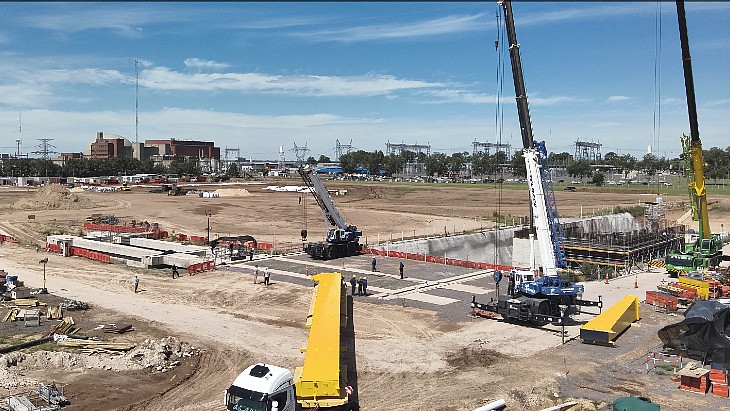
The crane was developed by IMPSA, based on a technical specification from Nucleoelectrica.
Installation and commissioning of the equipment is scheduled to take place over a four-month period this year.
According to Nucleoelectrica, the dry storage facility is now 38% complete and is "essential ... to ensure the future operation of Atucha 2 and to guarantee the responsible management of nuclear fuel". It said that the capacity of the current storage pools at the site is scheduled to be reached in December 2027.
The company says that the high-strength concrete base has been completed and "construction is progressing on system components, including containers, shielded lids, and supporting steel structures".
It said the new facility is designed with passive ventilation, which will ensure temperatures remain within safe ranges without the need for electrical power or human intervention. The gantry crane has been designed to ensure the ability to safely handle and place the storage containers for used nuclear fuel during dry storage operations.
A dry fuel storage facility for the Atucha 1 nuclear power plant was opened in 2022 to store fuel assemblies used in the pressurised heavy water reactor.
Situated about 100 kilometres northwest of Buenos Aires, Atucha 1 has been generating electricity since 1974. The fuel bundles used by unit 1 of the plant had previously been stored within the reactor building, but a decision was made to increase the storage space available as part of a project to increase its service life.
Atucha 2 is a 693 MWe pressurised heavy water reactor and was ordered in 1979. It was a Siemens design, a larger version of the first unit at Atucha, and construction started in 1981 by a joint venture of Argentina's National Atomic Energy Commission and Germany's Siemens-Kraftwerk Union. However, work proceeded slowly due to lack of funds and was suspended in 1994 with the plant 81% complete.
In 1994, Nucleoeléctrica Argentina was set up to take over the nuclear power plants from CNEA and oversee construction of Atucha 2. In 2003, plans for completing Atucha 2 were presented to the government. The government announced a strategic plan in August 2006 for the country's nuclear power sector, including completion of Atucha 2. The unit was effectively completed in September 2011. First criticality was achieved early in June 2014, and grid connection was later that month, with full power in February 2015.


_51287.jpg)