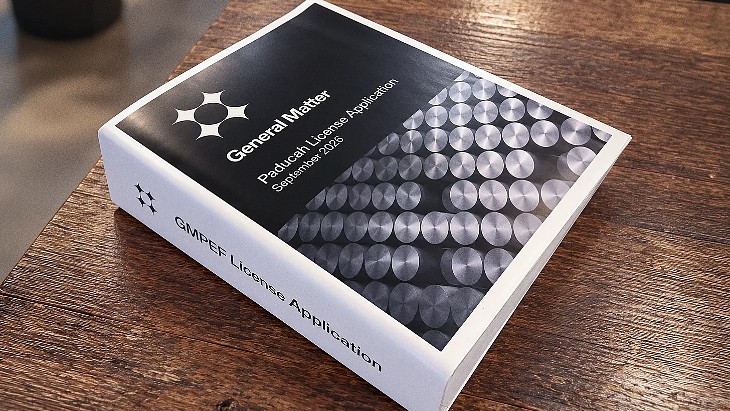
The company says that its application, stretching to more than 1,000 pages, "contains comprehensive evaluations of the facility’s safety and impact, including our integrated safety analysis, environmental report, fire hazards analysis, decommissioning funding plan, security protocols, emergency plans, and general operational processes".
It said the first licence application "was filed under 10 CFR Part 70, the standard federal process for uranium enrichment licenses, to produce special nuclear material at our facility in Paducah, Kentucky. Next year, we intend to submit an amendment to produce High-Assay Low-Enriched Uranium (HALEU)".
The idea behind submitting the licence application as two separate parts is to enable construction to begin sooner and lead to faster authorisation and licensing.
In its statement announcing the submission of the licence application, General Matter said: "We will enrich uranium at commercial scale by the end of the decade. We will end reliance on foreign adversaries for the nuclear fuel powering almost 20% of our grid. This approach is how we will produce LEU, LEU+, and HALEU by 2030."
Pre-construction work at the site has already been taking place, including clearing the site, soil works and utilities installation.
Background
General Matter was one of four companies selected in October 2024 by the US Department of Energy (DOE) to provide enrichment services to help establish a US supply of HALEU. The company did not emerge from stealth until April 2025, and in August 2025 signed a lease with the DOE for the reuse of federal land at the former Paducah Gaseous Diffusion Plant in Kentucky for a new commercial uranium enrichment facility.
_14317_d7260f6b.jpg)
How the site might look (Image: General Matter)
The lease covers a 100-acre parcel of land at the site and provides General Matter with a minimum of 7,600 cylinders of existing uranium hexafluoride to supply fuel for future re-enrichment operations.
Unenriched, or natural, uranium contains about 0.7% of fissile uranium-235 (U-235), the isotope of uranium that is capable of undergoing the fission process by which energy is produced in a nuclear reactor. Enrichment increases the concentration of the fissile isotope, typically by passing gaseous uranium hexafluoride through gas centrifuges.
Most nuclear reactors need fuel containing between 3.5% and 5% U-235, which is known as LEU. The fuel that will be needed by the advanced reactor designs that are now being developed - and many small modular reactors - requires still higher enrichments. Fuel with enrichment levels of 5-10% U-235 is known as LEU+; HALEU contains 10-20% U-235.
The USA has been dependent on uranium enrichment from overseas enterprises since the last domestically-owned commercial uranium enrichment capacity, the Paducah gaseous diffusion plant, closed in 2013. Since then, the Urenco USA plant at Eunice in New Mexico - a plant using a European centrifuge design manufactured in the Netherlands - has been the only commercial enrichment capacity in the USA.


_76412.jpg)
_38809.jpg)
_15774.jpg)