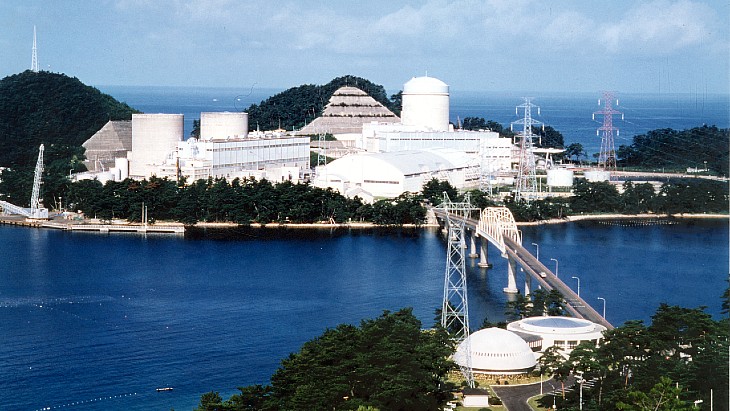
An International Atomic Energy Agency team of experts has completed a review of long-term operational safety of unit 3 of Kansai Electric Power Company's Mihama nuclear power plant in Japan, which reviewed the plant's response to recommendations and suggestions made during a mission in 2024.
The IAEA team on 13 November completed a four-day Safety Aspects of Long-Term Operation (SALTO) mission to Mihama 3, carried out at Kansai's request. The review focused on aspects essential to the safe Long-Term Operation of unit 3.
A SALTO peer review is a comprehensive safety review addressing strategy and key elements for the safe long-term operation of nuclear power plants. SALTO missions complement IAEA Operational Safety Review Team (OSART) missions which are designed as a review of programmes and activities essential to operational safety. SALTO peer reviews can be carried out at any time during the lifetime of a nuclear power plant, although according to the IAEA the most suitable time lies within the last ten years of the plant's originally foreseen operating period. SALTO and OSART reviews are carried out at the request of the IAEA member country in which the review is to take place.
The IAEA conducted a ten-day SALTO mission to Mihama 3 in April 2024. Its recommendations and suggestions included that the plant should further develop and implement its Long-Term Operation programme and should fully develop and complete the ageing management review process for mechanical, electrical, and instrumentation and control components and civil structures. It also said the plant should improve its so-called equipment qualification programme, designed to confirm the resistance of components to harsh conditions.
The latest SALTO mission - comprising two experts from the Czech Republic and Sweden, and two IAEA staff members - found the plant has completed the development of a comprehensive Long-Term Operation programme ensuring that all activities are systematically planned, and clear responsibilities are assigned; improved and completed the implementation of ageing management activities for civil structures; and developed and implemented an adequate equipment qualification programme for electric, instrumentation and control, and active mechanical components.
However, the team noted that the plant needs to continue its work to: ensure the adequate coordination and oversight of ageing management activities including the definition of appropriate indicators; ensure the adequate analysis and use of external operating experience from external organizations in the area of Long-Term Operation; and improve the analysis and management of data relevant for ageing management.
"The team noted the plant is working on the SALTO team's suggestions and recommendations from the 2024 review," said team leader and IAEA Nuclear Safety Officer Martin Marchena. "Based on its efforts, the plant has made improvements in ageing management and resolved many of the findings identified in 2024. The team believes the plant is on track to complete most of the remaining items in a reasonable timeframe."
"KEPCO is committed to continuously improving safety based on the recommendations and suggestions received during the 2024 SALTO mission," said Kazutaka Tsuru, manager of the Mihama plant. "Over the past two and a half years, we have incorporated the insights gained from the review into our activities and worked to make improvements. We will take the results of this follow-up review as a new starting point and continue to make improvements with safety as our highest priority. As a pioneer in the long-term operation of nuclear power plants in Japan, we also intend to share the experience and knowledge gained with other nuclear power plants in Japan and contribute to safe long-term operation across the country."
The background
Under revised regulations which came into force in July 2013, Japanese reactors have a nominal operating period of 40 years. Extensions can be granted once only and limited to a maximum of 20 years, contingent on exacting safety requirements.
In November 2016, Japan's Nuclear Regulation Authority (NRA) approved an extension to the operating period for Kansai's Mihama unit 3, a 780 MWe pressurised water reactor that entered commercial operation in 1976. The NRA's decision cleared the unit to operate until 2036. Mihama 3 was the third Japanese unit to be granted a licence extension enabling it to operate beyond 40 years under the revised regulations, following Kansai's Takahama 1 and 2 which received NRA approval in June 2016.
Mihama 3 was restarted in June 2021 after having been idle since May 2011 following the accident at the Fukushima Daiichi plant two months earlier. It became the first Japanese power reactor to operate beyond 40 years.
Units 1 and 2 of the Mihama plant were permanently shut down in April 2015.