According to World Nuclear Association’s World Nuclear Outlook Report - which was published in full ahead of the climate summit gathering in Turkey - there was 423 GWe of nuclear capacity at the end 2025 and there is currently 88 GWe of new capacity under construction.
There is a widespread goal of at least tripling nuclear energy capacity by 2050 - 39 countries have now signed the declaration which was launched with 22 signatories during COP28. Six have done so since COP30 - Belgium, Brazil, China, Italy, South Africa and Togo.
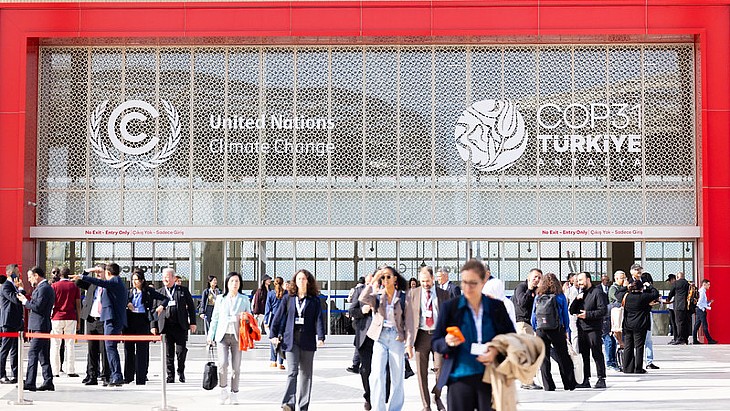
Director General of World Nuclear Association, Sama Bilbao y León, speaking at COP31, the United Nations Climate Conference, said: "The conversation has moved from whether we triple nuclear capacity to how fast we can deliver it. That depends on decisions made in the next few years: making the most of the existing fleet, completing projects under way, committing to the next ones, unlocking investment, and investing in people and supply chains.
"There is one more ask for COP31. The Presidency's pledge to raise electricity to 35% of final energy demand by 2035 is a welcome ambition, but it does not specifically acknowledge the role nuclear could play. Reactors already under construction will add around 88 GWe by then, including four reactors here in Türkiye, and more will come from reactors due to start construction over the next few years. Clean energy should be treated on equal terms."
At the moment electricity accounts for about 23% of global final energy consumption and to achieve the 35% goal would require a huge amount of new capacity - according to the International Energy Agency it would need an increase of more than 15,000 terawatt-hours in global electricity generation, equivalent to nearly half of today's output, requiring between 3,000 to 5,000 GWe of new generating capacity, depending on the mix of sources and capacity factor.
The draft of the COP31 35-by-35 Global Electrification Pledge, published in September, says that: "Recognising that achieving the goals of the Paris Agreement and keeping 1.5 degrees alive requires accelerated progress across a broad range of technologies and approaches, including in energy efficiency, renewable energy deployment, electrification, emissions abatement and removals, and other technologies and approaches of end uses across transport, buildings and industry … recognising that increasing electricity's share of final energy consumption can complement and reinforce existing efforts to expand renewable energy and improve energy efficiency by translating electricity supply into economy-wide emissions reductions…
"We declare our intent to work collaboratively and expeditiously to pursue the following objective: To increase electricity's share of total final energy consumption, to reach 35% globally by 2035 ('35 by 35'), in line with pathways consistent with keeping 1.5°C alive and complementary to efforts to expand renewable energy and improve energy efficiency."
A letter to COP31 President, and Turkey's Environment Minister, Murat Kurum, coordinated by Nuclear for Climate which was formed by more than 150 associations worldwide, says: "Climate action must serve both the countries reducing emissions from existing energy systems and communities gaining access to electricity for the first time. Nuclear energy can support meeting both needs, supplying reliable, low-emission electricity and heat at scale, while strengthening energy independence and supporting climate prosperity."
It urges: "In line with the Clean Energy Transition and Electrification Priority, and following the Global Stocktake decision calling for accelerating low-emission technologies, including, inter alia, renewables and nuclear, we urge the global community to advance nuclear energy in the implementation of the '35 by 35' Electrification target, as a low-carbon, firm, reliable and affordable source of electricity."
It also calls for the "Climate Implementation Bridge to expressly include nuclear" and calls for "integrating nuclear energy in green industrialisation strategies. It is an enabler of competitive, resilient and low-carbon industrial production, supporting the decarbonisation of hard-to-abate sectors through electricity, heat and hydrogen production."
French environment minister Monique Barbut, speaking at a COP31 event co-hosted by the French government, Comité Stratégique de la Filière Nucléaire and World Nuclear Association highlighting the momentum behind the declaration to triple nuclear capacity by 2050, said: "Here at COP31, the message is clear: the momentum behind the declaration continues to build. France will keep working with its partners to mobilise the finance, cooperation and international support needed to turn this commitment into reality."
Togo's Minister of Mines and Energy Resources, Robert Koffi Messan Eklo, said: "Africa's energy future will be built on ambition, innovation, and clean power. Togo's commitment to nuclear energy is a powerful signal of that future."
The World Nuclear Outlook Report also highlights the importance of extending the lifetimes of existing nuclear capacity, noting that about half of global nuclear capacity will have been operating for between 60 to 80 years by 2050. It says that life extensions of existing capacity are the most cost-effective form of additional low-carbon generation, and will be important, alongside new capacity, to hitting capacity expansion targets.