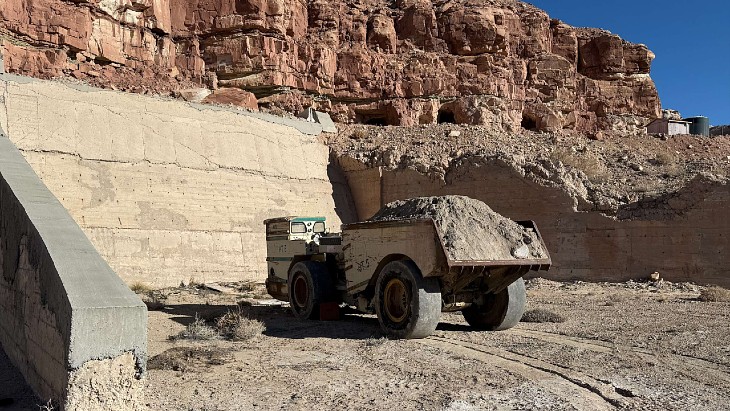
The agreement is to combine IsoEnergy's portfolio of past-producing conventional uranium mines in Utah - Tony M Mine, Daneros Mine, Rim Mine, Sage Plain Project, and Flatiron Project - and DISA's High-Pressure Slurry Ablation (HPSA) processing technology and remediation and recovery business.
DISA Uranium has received a commitment for USD105 million of financing "supported by a consortium of leading mining, energy, and technology investors, including Tembo Capital, BHP Ventures, Galvanize Climate Solutions, Valor Equity Partners, Evok Innovations, Halliburton Labs, and Veriten". IsoEnergy, which will own around 33% of the new company, is to "participate in the financing in the amount of USD 33 million".
The financing will be used "to advance DISA Uranium's conventional mine development, fund remediation and recovery programmes, progress domestic uranium milling infrastructure, and support the Company's long-term growth".
Philip Williams, CEO of IsoEnergy, said: "The creation of DISA Uranium marks an important step in advancing IsoEnergy's strategy of building a globally diversified, development-ready uranium platform. By contributing our permitted, past-producing Utah asset base and pairing it with DISA's proprietary HPSA technology, we believe we can enhance project economics, expand the universe of viable conventional uranium resources, and ultimately support domestic processing infrastructure. At a time when the United States is placing renewed emphasis on nuclear energy, energy security, and the reshoring of its nuclear fuel supply chain, we believe this partnership is both timely and highly differentiated."
Greyson Buckingham, CEO of DISA Uranium, said: "DISA Uranium was built on a straightforward idea: much of the uranium this country needs is already out of the ground, sitting in waste piles across the West. Remediating those abandoned mine sites and recovering the uranium and vanadium they hold is the core of our business, and the reason we hold the only NRC licence of its kind. IsoEnergy's Utah Portfolio extends that platform - HPSA is designed to make those conventional assets meaningfully more economic by upgrading feedstock at the mine site and reducing what has to be transported and processed. Together, recovered legacy material and a scaled conventional resource base give us the feedstock to bring to life a new domestic uranium recycling and processing facility, the missing link in rebuilding an independent American nuclear fuel supply."
The US Nuclear Regulatory Commission (NRC) accepted Disa's application for a licence to use its technology to remediate abandoned mine waste at inactive mine sites in April last year. The patented HPSA technology is a mechanical process leveraging collisions between particles. It exploits the difference in Mohs hardness - a scale for measuring the relative hardness of minerals - between a base mineral and target mineral to selectively liberate the target mineral. The process can be used to upgrade critical minerals from both mined ore and legacy waste.
There are more than 15,000 sites associated with abandoned uranium mine waste across the western USA, largely from Cold War-era mining activities. Many of these sites are located on or near tribal lands. But options to safely treat or contain the contaminated material have up to now been limited and costly.
HPSA technology is said to offer a scalable method to remediate this waste safely and economically, separating and cleaning the material at the source, and making it possible to recycle uranium while dramatically reducing the volume of material requiring long-term disposal.
The NRC licence allows DISA to deploy its High-Pressure Slurry Ablation systems under federal oversight to treat abandoned uranium mine waste across multiple states. In announcing the creation of DISA Uranium, the companies say HPSA has moved beyond the pilot stage and been commercially validated.
Before the closing of the transaction, DISA will spin-out its non-uranium and vanadium mineral processing business into a new independent business, DISA Tech.


_29695_19459.jpg)
_98552.jpg)
_1_12560.jpg)
_22582.jpg)