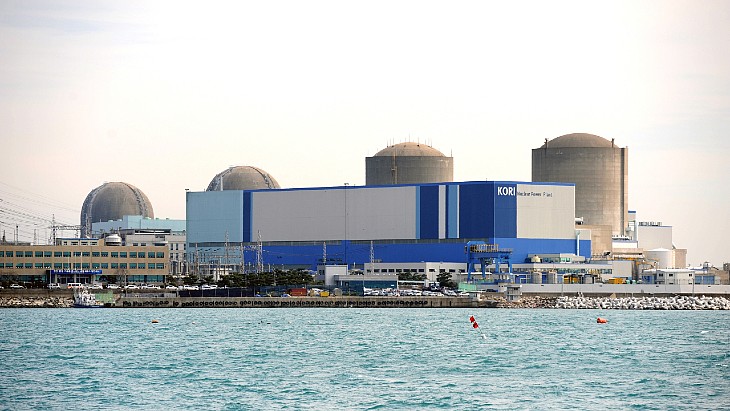
Kori unit 2 - South Korea's second nuclear power reactor - began commercial operation in August 1983. The 685 MWe pressurised water reactor's operating permit expired on 8 April 2023, and it has remained offline since. Korea Hydro & Nuclear Power (KHNP) submitted a safety assessment report for continued operation of Kori 2 in April 2022 and applied for a permit for continued operation, including the results of a public opinion survey on the radiation environmental impact assessment.
The Nuclear Safety and Security Commission (NSSC) approved the continued operation of Kori unit 2 until 2033 in November last year.
The NSSC has now completed inspections and confirmed the reactor can be restarted.
The NSSC verified design changes to accident management facilities, such as the reactor coolant external injection path, and improvements, such as the installation of facilities to supply power to essential accident response equipment. While inspecting the performance of facilities to ensure they operated according to the accident management plan, the NSSC also conducted an intensive inspection to ensure that the accident response strategy was effectively functioning on-site.
In addition, it was confirmed that 10 safety measures required to be completed prior to restarting operations under the permit for continued operation, as well as cable replacement to ensure safety margins, were all properly implemented in accordance with technical standards, and additionally, all equipment improvements based on fire risk analysis, such as the installation of new fire monitors, were also completed.
In particular, considering that Kori 2 has been shut down for an extended period, a focused inspection was conducted on safety-related pumps and valves, and it was confirmed that the test cycle and operational performance met the relevant standards, and that steam generator management was also properly implemented. In addition, as a result of conducting inspections on 94 items out of a total of 102 periodic inspection items, including safety inspections for the replacement of the passive catalytic hydrogen recombiner for severe accidents and steam generator tube integrity inspections, it was confirmed that reactor criticality can be safely achieved in the future.
KHNP is currently submitting safety assessment reports for the continued operation of nine other nuclear power units (Kori 3 and 4, Hanbit 1 and 2, Hanul 1 and 2, and Wolsong 2, 3, and 4), whose operating licences expire before 2030, to the NSSC for review.
Operation of units 3 and 4 at the Kori plant was suspended in September 2024 and August last year, respectively, as their 40-year design lives had expired.
Unit 1 of the Kori plant was permanently shut down in June 2017, after 40 years of operation, and become the first South Korean reactor to enter decommissioning. KHNP submitted its application to dismantle the unit to the NSSC in May 2021. The regulator approved the decommissioning of Kori 1 in June last year.


_51287.jpg)
_42437.jpg)