In 2050, we will look back on 2025 as a pivotal time. The question is not whether this period was a turning point, but how boldly we chose the right decisions - on investment, on people and on partnerships - to deliver the nuclear capacity the world needs. The purpose of leadership today is to make sure that when future generations look back, they see this decade as the moment we accelerated.
According to the Interbational Energy Agency (IEA), more than 67 million people now work in the energy sector globally. Clean energy has, for the first time, become the majority employer, with around 35 million roles across renewables, nuclear, grids and efficiency. As 33 nations move to triple nuclear energy the decisions leaders take now will shape not only how much clean electricity is built, but how many high-skill, long-term careers are created in every region.
We are all familiar with the Final Investment Decision (FID), a key milestone that often makes headlines when mega-projects secure funding to proceed. Behind every FID are leaders who have inspired belief and action in others to achieve their shared goal. That investment, however, is not only financial. According to a recent NICE Clean Energy Ministerial report, each gigawatt of nuclear capacity typically creates around 4,000–5,000 jobs (direct, indirect and induced), underlining how decisions taken today will shape livelihoods and communities for decades to come. In other words, every FID in nuclear today is also a decision about the workforce that will carry our plants safely through to 2050 and beyond.
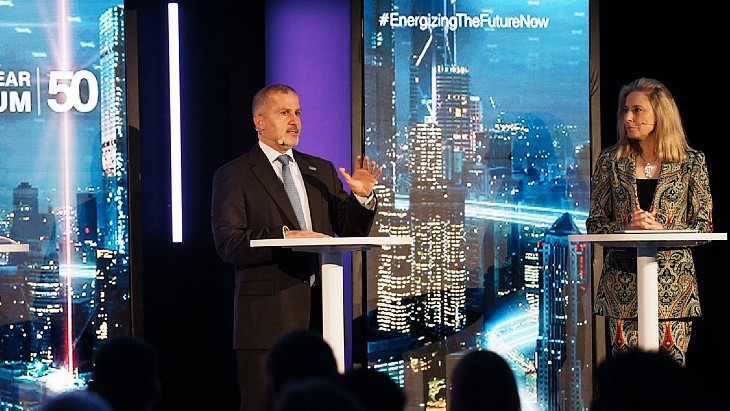
A leader can be anyone who creates a vision, inspires others to believe in that vision, and then goes on to make it a reality. This means that anyone, in any role, at any level of an organisation, can be a leader. The executives who will lead our sector in 10 or 20 years are almost certainly displaying their leadership skills on a smaller scale today. Al Hammadi observes how effective some of the younger generation of leaders are in "innovating and thinking outside of tradition" while also "capitalising on the wealth of knowledge and experience" that already exists. For him, one of the most important tasks of senior leaders is to ensure that younger professionals are present at key events and embedded in major projects, so they can build on the experiences of those who have built and operated plants over many decades. Bilbao y León agrees - leadership is not about "being in charge" it is about "being responsible for those in your charge, empowering and enabling them".
The next 20 years promise to be the most transformative in the sector's history. Electricity demand is rising sharply with electrification, digitalisation and AI, and clean energy already employs more people than fossil fuels globally, according to the IEA. We now need visionary leaders who are ready to lead decisively, continuing the acceleration already under way.
Turning plans into delivery at record pace is critical if we are to seize this moment of growth. This is a mindset shift from "What are we going to do?" to "How are we going to make this happen, now?", in how we plan for skills, training and long-term careers.
Al Hammadi sees a particular opportunity - and responsibility - in how the sector engages its youth. Globally, around a third of the world's population is under 20, and in many emerging economies the proportion is even higher. For nuclear, that means the engineers, operators and regulators who will be running the fleet in 2050 are in schools, universities and early-career roles today. He argues that every major nuclear energy gathering should ensure young nuclear professionals are engaged, so that they may carry that knowledge back into their organisations.
The collaborative nature of the nuclear sector is a great asset, but knowledge sharing does not happen automatically; it must be led, structured and valued. There are leaders at all levels within the sector who have truly led by example and inspired others to collectively make their vision a reality.
For Bilbao y León, the combined effect of thousands of such leaders - project managers, shift supervisors, reactor operators, site engineers, radiation protection specialists, regulators and educators - will determine whether the sector can deliver on the targets now being set. Clean energy is already one of the fastest-growing sources of employment in the global economy, and nuclear has a distinctive contribution to make: long-term, highly skilled jobs that anchor local communities while providing reliable, low-carbon power for industry, cities and digital infrastructure.
By 2050, those looking back at this period will ask whether we matched our ambitions for clean energy with unleashing ambition on people: whether we invested early enough in skills, created clear pathways for young professionals, and used international platforms to share experiences and knowledge as effectively as we shared technology.
The need is there, the technology is there, and the funding is increasingly available. Strong leadership - in governments, utilities, regulators, universities and companies of every size - will ensure that we can say, with conviction in 2050 that we took the right decisions in 2025.


_51287.jpg)