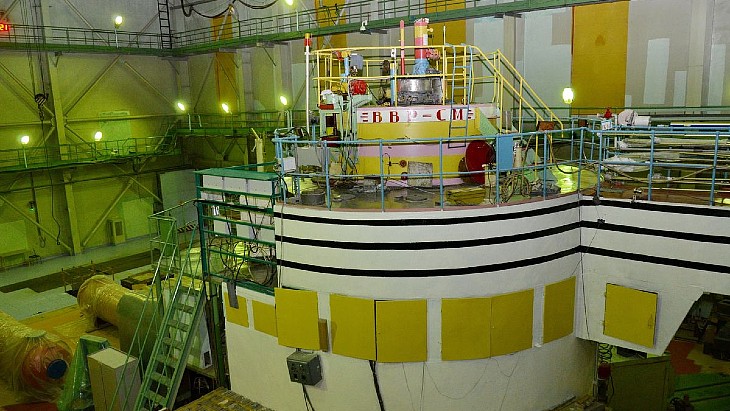
The higher uranium concentration allows for a proportional increase in the fuel's life in the WWR-SM reactor, Rosatom said. The reactor is used for research in the fields of nuclear physics, radiation materials science, mineral irradiation, and in the production of radioisotopes for medical and industrial purposes. According to Rosatom's Strana Rosatom publication, "Uzbek iodine-125 accounts for approximately 80% of the global market. The reactor is also a jeweller. Since 2005, it has been working its magic on topazes: irradiated stones acquire a rich colour, so prized in jewellery".
TVEL, which is the fuel division of Rosatom, said it supplies nuclear fuel for research reactors in nine countries. The fuel supply for the research reactor in Uzbekistan is part of developing links between the two countries, which includes the planned construction of an RITM-200N small modular reactor as the first part of Uzbekistan's planned nuclear power plant.
Uzbekistan's WWR research reactor in Ulugbek, near Tashkent, began operating in September 1959 with a power of 2 MWt. In 1980, the reactor's power was raised to 10 MWt and it became known as the WWR-SM. In 2008, the International Atomic Energy Agency supported the successful conversion of the reactor from highly enriched uranium (HEU) fuel to low enriched uranium (LEU) fuel. The reactor was closed down in July 2016 with its decommissioning expected to begin shortly afterwards, but in February 2017 it was decided instead to upgrade and restart it in July the same year.
The WWR-SM operated on 90% HEU fuel from 1979 until August 1998, when it was converted to 36% HEU under a Russian programme to eliminate the use of 90% HEU in Soviet-supplied reactors abroad. However, HEU is seen as a potential nuclear proliferation risk. In 2008, the reactor was converted to use LEU fuel (19.7%). After seven transfers of HEU from the facility to Russia, in November 2012 the US National Nuclear Security Administration announced that the INP facility had been completely cleared of HEU.


_51287.jpg)