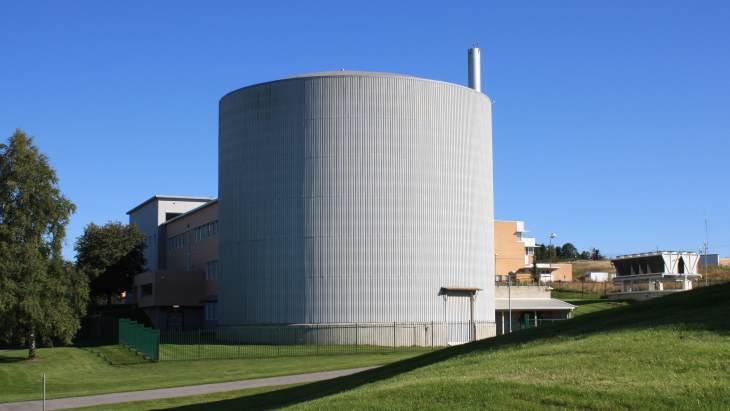
Norway holds about 16.5 tonnes of used fuel from six decades of operating nuclear research reactors. Much of it cannot be stored long term or disposed of in its current form. The inventory includes metallic uranium fuel, aluminium-clad fuel and experimental fuels.
Following an international tender for a suitable storage system, Norwegian Nuclear Decommissioning received four offers. With the NAC agreement, work on new storage and transport solutions enters a more concrete phase, and once the used fuel has been moved out of the current storage solution, it will open the way for further dismantling of the nuclear facilities that Norwegian Nuclear Decommissioning has been given responsibility for decommissioning.
Using NAC's solution, the used fuel will be stored in a stainless steel container, surrounded by a protective concrete silo. For transport, a separate transport container will be used, not the concrete silo itself. The storage solution is designed for passive dry storage and has a design life of more than 70 years.
Last month, Norwegian Nuclear Decommissioning signed an agreement with Swedish nuclear technical services provider Studsvik to manage used nuclear fuel from the former research reactors at Halden and Kjeller. Under that agreement, which runs until 2055, Studsvik will transport the fuel to its licensed facilities at Studsvik outside Nyköping, Sweden, inspect it and, where required, treat it, including oxidation of metallic uranium fuel, to prepare it for interim storage and final disposal. The treated fuel will remain at Studsvik until it is returned to Norway for final disposal.
"The casks could be important in enabling such treatment," Norwegian Nuclear Decommissioning said. "The transport will take place when the necessary permits and approvals are in place. The casks could also contribute to increasing the safety of the Norwegian nuclear facilities by allowing some of the current solutions to be phased out more quickly, i.e. both in parallel with treatment at Studsvik, and as a supplement to such treatment for some types of fuel. The casks will also be used when the spent fuel returns from Sweden."
"This is good work by everyone involved who has managed to bring an important agreement to fruition," said Norwegian Nuclear Decommissioning Director Pål Mikkelsen. "Together with the agreement with Studsvik, we now have good solutions for the further decommissioning work."
Before the solution can be put into use, NAC will collaborate with Norwegian Nuclear Decommissioning and the Institute for Energy Technology on design, analysis and safety documentation. The development work also includes additional equipment, plans for inspection, maintenance and training. NAC anticipates a development period of 22 months, with start-up dependent on the necessary security agreement being in place. The documentation will then be reviewed before Norwegian Nuclear Decommissioning and the Institute for Energy Technology submit the documentation to the authorities for processing.
The background
Norway's two research reactors - the nuclear fuel and materials testing reactor at Halden and the JEEP-II neutron scattering facility at Kjeller - were declared permanently shut down in June 2018 and April 2019, respectively. In addition to the research reactors, there are several other nuclear facilities that will be decommissioned and a wide range of nuclear waste that must be handled and disposed of in a safe way. The clean-up activities are estimated to cost more than NOK21 billion (USD2.2 billion) and will last for at least 20 years.
Norwegian Nuclear Decommissioning, established in 2018 as a government agency under the Ministry of Trade, Industry and Fisheries, is responsible for decommissioning the research reactors and other related nuclear infrastructure. It is also responsible for the safe handling, storage and disposal of nuclear waste in Norway.
The nuclear facilities in Halden were transferred from the Institute for Energy Technology to Norwegian Nuclear Decommissioning on 1 April last year. Last month, the latter submitted a licence application to the country's nuclear regulator to take over responsibility for the nuclear facilities at Kjeller.
Norwegian Nuclear Decommissioning plans to build a range of different facilities for the storage and disposal of radioactive waste: storage for low- and intermediate-level radioactive waste; storage for used nuclear fuel; a treatment plant where waste can be sorted, processed and treated; and final disposal landfills, "including deep disposal for used fuel/high-level radioactive waste".