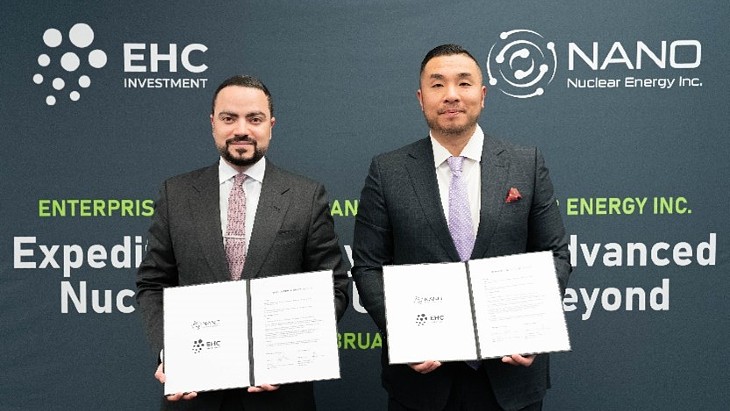
The memorandum of understanding (MoU) will see NANO collaborate with EHC - a 35-year-old diversified investment holding company which is a subsidiary of International Holding Company - to "identify and evaluate opportunities to enter and engage select regional markets, assess pathways for establishing a nuclear supply chain, and identify potential future commercial agreements with EHC or other third-party stakeholders. The collaboration will also explore opportunities to support national and regional clean energy objectives".
They will also look at potential end users and host sites for deployment of KRONOS MMRs, "including industrial facilities, data centres, and other energy-intensive infrastructure".
The KRONOS MMR is a 45 MW thermal, 15 MW electrical high-temperature gas-cooled reactor, using TRISO (tri-structural isotropic) fuel in prismatic graphite blocks and has a sealed transportable core. NANO says its MMR uses no water and has no need for an electrical grid or infrastructure support and can be transported by road and assembled on site. And it is possible for multiple units to be configured "to deliver gigawatt-level power".
Ali Al Gebely, Managing Director of EHC, pictured above, left, said: "This collaboration reflects our long-term commitment to positioning the UAE at the forefront of next-generation energy technologies. Micro modular reactors offer a transformative solution to deliver reliable, carbon-free power to critical infrastructure, including data centres and industrial ecosystems. Through our collaboration with NANO Nuclear, we aim to enable scalable nuclear deployment, strengthen national energy resilience, and contribute meaningfully to the UAE's clean energy and advanced technology leadership ambitions."
Jay Yu, Founder and Chairman of NANO Nuclear, pictured above, right, said: "This memorandum of understanding represents an important first step for NANO Nuclear in the Gulf region and reflects our broader vision to develop modular, scalable, and reliable advanced nuclear energy technologies on a global basis. The steps we take in the coming months with EHC will help us better understand regional opportunities and align our objectives with those of local stakeholders. We anticipate that this engagement will lead to additional agreements and enable NANO Nuclear to take meaningful steps toward supporting the development of the Gulf region’s nuclear power capabilities. We look forward to building on this momentum and identifying further opportunities where our expertise can contribute to the ... energy needs of the UAE and beyond."
The UAE has existing nuclear energy capacity at the four-unit Barakah Nuclear Power Plant, whose first unit entered commercial operation in 2021. The plant meets about 25% of the UAE's electricity needs.


_29695_19459.jpg)
_98552.jpg)
_1_12560.jpg)
_22582.jpg)