The 13-person team from the Moscow Centre of the World Association of Nuclear Operators (WANO) observed operations, examined technical documentation and focused on "organisation and administration, maintenance and repairs, engineering support, radiation protection, operating experience, emergency preparedness, and other fields".
According to Rosatom "the review identified fewer areas for improvement than the 2022 assessment".
Viktor Yelagin, director of the floating nuclear power plant (FNPP), said: "These findings rank the FNPP on a par with Russia's top nuclear power plants, including the Balakovo and Kalinin NPPs. They highlight the exceptional expertise of the plant's management and team, who maintain safety and operational standards in line with both Russian and global best practices. This success was driven by the daily, meticulous efforts of all FNPP managers and employees to improve production performance."
What is WANO?
WANO aims to connect every company and country in the world that has an operating nuclear power plant, or a new unit under construction, "to achieve the highest possible standards of nuclear safety".
It was created following the Chernobyl accident in 1986, an event which "made it clear that an event at one plant impacted every plant and that nuclear safety was everyone’s business". It operates with strict confidentiality, allowing experts from operating units to carry out peer reviews at other member units, where, using their experiences, they can provide support and advice.
The Akademik Lomonosov
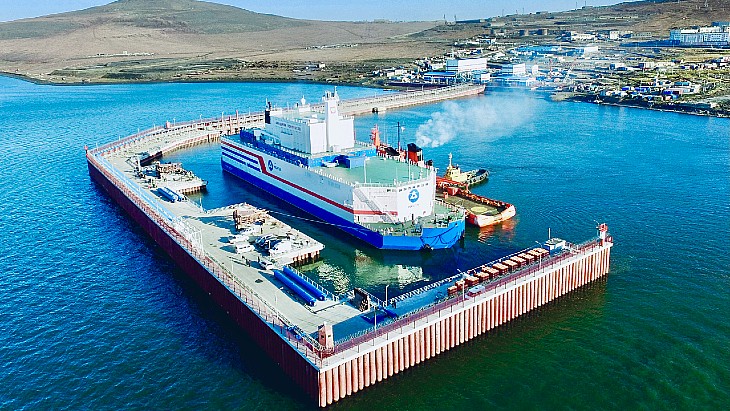
The Akademik Lomonosov began commercial operation in May 2020 and is the world's only operating floating nuclear power plant. It is based, with its coastal infrastructure, by the city of Pevek - population 5,000 - to which it supplies heat and power in Russia's Arctic Chukotka region.
The Akademik Lomonosov has two KLT-40S reactors generating 35 MWe each, which are similar to those used in a previous generation of nuclear-powered icebreakers. It is also providing energy for the development of mining of the Baimskaya ore zone. It has the capacity to provide electricity to a city with a population of up to 100,000 people.
Rosatom is in the process of constructing four floating power units and is targeting the export market for floating nuclear power plants with capacity of at least 100 MWe and an assigned service life of up to 60 years featuring RITM-200M reactors, derived from those used on Russia's latest nuclear-powered icebreakers.


_1_12560.jpg)
_55462.jpg)


_84289_33276.jpg)