Minor actinides - notably neptunium, americium and curium - are a group of transuranic elements that do not occur naturally but are formed in nuclear fuel during reactor operation. They are only a small share of the used fuel mass, but contribute heavily to its radioactive toxicity and residual heat release.
Isotopes of minor actinides are extremely long-lived - with half-lives of hundreds of thousands of years - and it is their presence that determines the duration and conditions for radioactive waste isolation from the environment, Rosatom said, adding that fast neutron reactors are suitable for "burning" of minor actinides "as they provide transmutation of minor actinides into more stable or short-lived isotopes".
The long-term aim is to reduce the volume and range of radioactive waste needing deep geological disposal, with Rosatom saying that eliminating minor actinides "could achieve radiation equivalence between the original uranium feedstock and the nuclear waste destined for isolation hundreds of times faster".
Alexander Ugryumov, Senior Vice President for Research and Development at TVEL, which is Rosatom's fuel division, said: "Burning minor actinides in a commercial reactor is not a one-off experiment, but a long-term strategy. Before scaling this solution to an industrial level, we are demonstrating the very technological feasibility, that this idea actually works. At the next stage, we intend to increase the content of minor actinides in trial oxide MOX fuel assemblies. In addition, we plan to add minor actinides to nitride uranium-plutonium fuel for fast reactors, and also to test heterogeneous burning of 'minors'. In this case, minor actinides are not 'blended' into uranium-plutonium fuel matrix, but are placed in separate fuel rods or assemblies, which will be installed in specific zones of the reactor."
Yuri Nosov, Director of Beloyarsk NPP, said: "We expect that the quantity of minor actinides included in the fuel matrix will be substantially reduced, but this will be confirmed by further post-irradiation studies. These results would confirm the concept of minor actinides burning technology and define its role and significance within the balanced fuel cycle. It is anticipated to reduce the amount of radioactive waste for final isolation multiple times. The fourth-generation power units will contribute to enhancing the environmental safety and energy potential of nuclear power by allowing the use of used fuel instead of its storage. Over approximately 60 years of operation, such installations will be capable of utilising about four tonnes of minor actinides, which is more than several thermal reactors can produce."
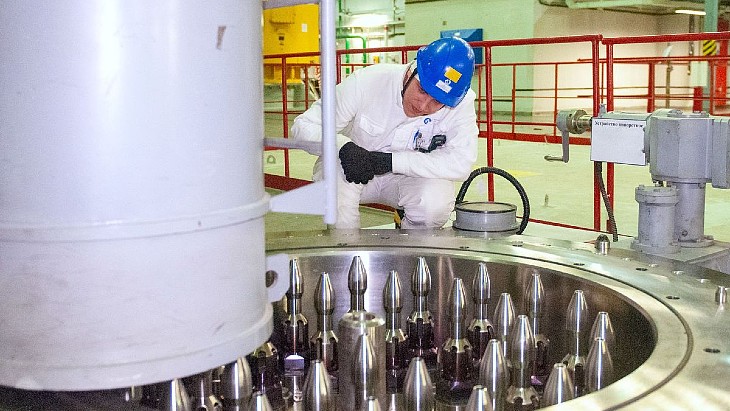
TVEL has described the pilot operation of the fuel assemblies in the BN-800 reactor as "the key stage of the comprehensive research programme" for minor actinides afterburning which began in 2021 and is due to run until 2035.
Beloyarsk 4 is a BN-800 reactor - a sodium-cooled fast reactor which produces about 820 MWe - which was brought to minimum controlled power for the first time in June 2014, and connected to the grid on 10 December 2015. The reactor entered commercial operation on 31 October 2016. It was fully loaded with MOX fuel in September 2022 and became the first such facility to complete a year operating on MOX fuel. MOX fuel is manufactured from plutonium recovered from used reactor fuel, mixed with depleted uranium which is a by-product from uranium enrichment.


_51287.jpg)
_42437.jpg)