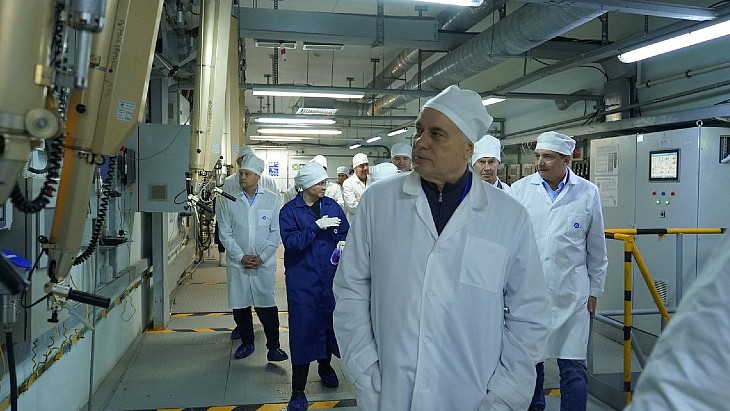
The Experimental and Demonstration Centre in Zheleznogorsk is part of Russia's goal of achieving a closed fuel cycle, and aims to recover valuable material from used fuel, which can then be reused in the production of fresh fuel for fourth-generation energy systems.
Andrey Nikipelov, Deputy Director General for Mechanical Engineering and Industrial Solutions at Rosatom, said: "Used nuclear fuel is no longer an endpoint, but a starting point - a resource for generating new, clean, carbon-free energy. A closed fuel cycle also means returning valuable materials to production and consistently addressing issues that have been of the greatest public concern for decades, reducing the volume of radioactive waste and ensuring the safe isolation of what remains after reprocessing.
"If we maintain the planned pace of construction of the infrastructure involved in used nuclear fuel reprocessing, by 2050 we will be able to reduce the generation of high-level waste from NPP operations by 100 times ... for us, environmental responsibility isn't limited to generating low-carbon electricity. It encompasses the entire lifecycle of nuclear fuel."
Rosatom, which provided the update in a report on a visit to the site by State Duma deputies, also said infrastructure works were progressing for a laboratory being built underground in the same region by the National Operator for Radioactive Waste Management (NO RAO), which aims to scientifically substantiate the safe isolation of that radioactive waste which cannot be reused.
"At a depth of over 500 metres, in the gneiss rocks of the Nizhnekansky Granite Massif, scientists will study the feasibility of disposing of high- and intermediate-level long-lived radioactive waste in a geological environment. The laboratory's goal is to obtain experimental data to assess how reliably rock formations and engineered barriers can retain radionuclides for thousands of years," Rosatom said.
Rosatom said the new laboratory is scheduled to open in 2031.