Nuclear reactors worldwide generated 2,702 TWh of electricity in 2025, beating the previous year's record of 2,667 TWh. And the positive trend is also seen in a recent increase in construction starts, as shown by the chart below, which shows how it has fluctuated over the past 75 years, says Cobb, who is senior programme lead, climate, at World Nuclear Association.
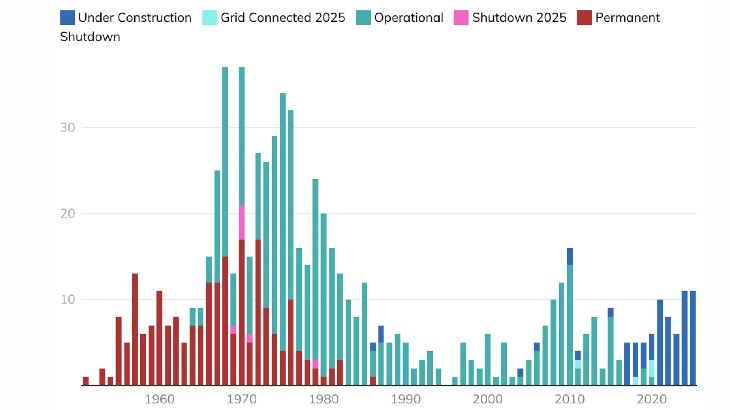
(Image: World Nuclear Association)
Cobb says: "That represents around 9% of world electricity. So we are seeing this increase in nuclear generation worldwide, principally at the moment in Asia, with other regions maintaining their levels of generation. But as we look to countries wanting to increase their nuclear capacity, and new build programmes coming into place, we would expect to see the nuclear generation rising in the future in all regions."
He also talks about the stats showing that the reliability of nuclear energy plants remains high across the global fleet and across the life of reactors, even as individual units age. The average capacity factor was 83.7% in 2025 (a capacity factor of 100% would be if a unit generated electricity 24 hours a day 365 days a year).
Looking ahead at the prospects for new nuclear capacity, the report projects that it could reach 1,457 GWe by 2050 if all national targets and goals are achieved and the existing fleet continues to operate. With current operating capacity being 423 GWe, that projected figure would be 200 GWe more than a tripling of the current levels.
New capacity under construction increased to 82 GWe, with eleven reactors starting construction in 2025. The combined total of planned, proposed and potential capacity has increased to 416 GWe, reducing the gap between actual projects and government targets. That means there is still about 550 GWe of capacity countries are targeting which has yet to become specific announced projects.
"So there is a need for governments, if they are going to reach the goals that they wish to reach, to take the measures and work with industry, work with finance community to bring on the plans for that additional capacity," he says.
Out of the ambitions for 1,457 GWe capacity by 2050, 1,303 GWe would be in countries which already have nuclear power reactors. There would be another 154 GWe of capacity that would be in countries that are either constructing their first reactors or are already planning to build reactors in the future, he says.
To help the process of achieving that goal, the report sets out 12 policy recommendations.
Cobb explains: "We have 12 connected policy priorities. They're not separate initiatives. The first is defining energy and sustainable economic policy. Governments need to give a clear, durable place for nuclear in national energy, climate, industry and development strategies and ensure that international frameworks recognise its contribution to security, resilience and decarbonisation. There's a need for work on financing and market design. Political risk needs to be reduced through long-term commitments. And you need to make sure that risks are allocated appropriately between public and private sectors.
"There are recommendations on regulation and permitting, on optimising the performance of existing reactors. Looking also at nuclear technology development and deployment. We also look very clearly at uranium and fuel supply, because it's obviously important if you're going to build a lot more reactors, to ensure that you have the mining, the conversion, the enrichment and fabrication all in place, expanding so it can meet the demand that those new reactors are going to generate. We also look at reprocessing and recycling for those countries that choose that route. For them, stable policy and predictable regulation is going to help improve resource use, strengthen fuel security.
"We also look at waste management, disposal and decommissioning. Every programme really needs an integrated, funded, long-term strategy, and we look at supply chain capability. Long-term order books can give suppliers the confidence to invest. Aligning standards and qualifying suitable industry-grade components could help broaden participation and lower costs. We need to look at industry policy and programme delivery. Nuclear projects should support regional development and high-value employment. But delivery also requires clear ownership, realistic schedules, collaborative contracts, and early supply chain involvement.
"And very much related to that is workforce and skills. Workforce planning needs to be put in place alongside programme design. That means expanding education and training, enabling international skills mobility, transferring expertise and creating retraining routes from adjacent industries needs to be put in place. And finally, of course, we need to bring the public along with us and other stakeholders. There needs to be public confidence and engagement. Trust is going to depend on accessible evidence about both the benefits and risks involved in projects, early stakeholder mapping and meaningful community participation."
So does Cobb think the tripling capacity target will be achieved? "I think there are some very good signs. What we have seen, even over less than a year since the last report, is that the number of planned projects has increased, the amount of under construction projects has increased. We are seeing that transfer from government goals into actual identifiable projects, and then into getting spades in the ground and starting construction. So we are starting to see that movement from ambition into action."
"The 2050 goal that was set may have seemed somewhat in the future, but it is less than 25 years away now. So we really, as an industry and as a society as a whole, need to be accelerating the steps that have been taken so far in order to deliver on those ambitions."
You can listen and subscribe on all major podcast platforms:
World Nuclear News podcast homepage
Apple
Spotify
Amazon Music
Episode credit: Presenter Alex Hunt. Co-produced and mixed by Pixelkisser Production
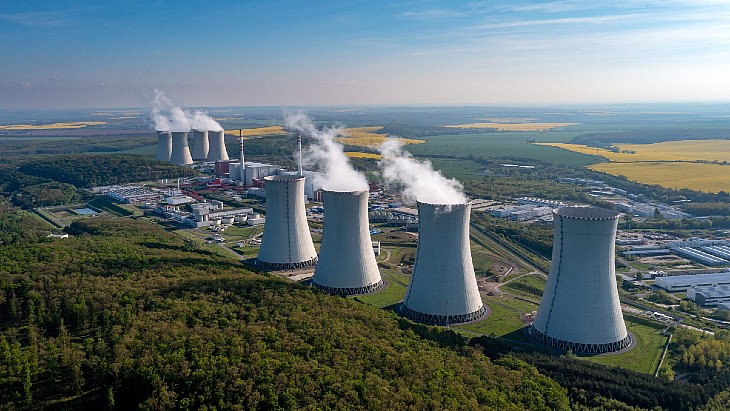
Cover Picture Credit: Adobe Stock/Vadym
Email newsletter:
Sign up to the World Nuclear News daily or weekly news round-ups


_55605.jpg)