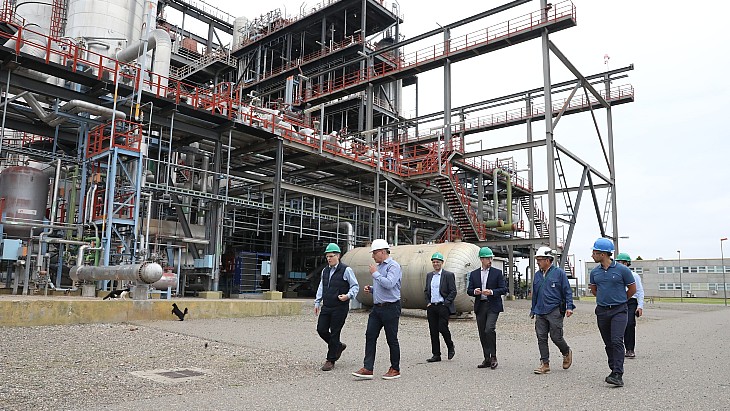
The National Atomic Energy Commission (CNEA) said that the work would involve modernisation, technological upgrades and refurbishment - and its maintenance role was designed to "preserve the plant's critical assets and prevent the so-called point of no return, where mechanical degradation could significantly hinder its future reactivation".
The Heavy Water Industrial Plant (Planta Industrial de Agua Pesada (PIAP)) at Neuquén supplied Argentina's nuclear programme from 1993 but was mothballed in 2017. With a capacity of 200 tonnes per year, it was the world's largest such facility, and it remains one of the most advanced.
The CNEA and the government of Neuquén province have been looking at restarting production in recent years, and have talked about the export potential.
CNEA said that since the plant was mothballed, "conservation and maintenance costs represented a significant burden for the national government, without the plant generating any revenue for the CNEA".
The "open and transparent" national and international tender process for the refurbishment "will allow progress toward a viable business model that generates revenue for the Commission and repositions Argentina as a heavy water producer".
Candu Energy, part of AtkinsRéalis, signed a memorandum of understanding (MoU) with the CNEA in May 2025 which provided for the restart of the Industrial Heavy Water Plant "along with the long-term acquisition of its heavy water output. It also provides for planning related to the establishment of one or more similar heavy water production facilities in Canada".
Heavy water - water containing an elevated concentration of molecules with deuterium ("heavy hydrogen") atoms - is used as a moderator and coolant in Candu reactors, which use unenriched uranium fuel.
In 2023 the CNEA said that Argentina's nuclear power plants, Atucha I, Atucha II and Embalse, would between them require some 485 tonnes of heavy water through to their planned retirements and suggested the remainder of production could be exported to other countries using pressurised heavy water reactors - such as Canada, China, India, Romania and South Korea. The substance is also used in a range of scientific and technical applications including as a tracer in medical investigations and various types of spectroscopy.


_98552.jpg)
_1_12560.jpg)
_22582.jpg)


_84289_33276.jpg)