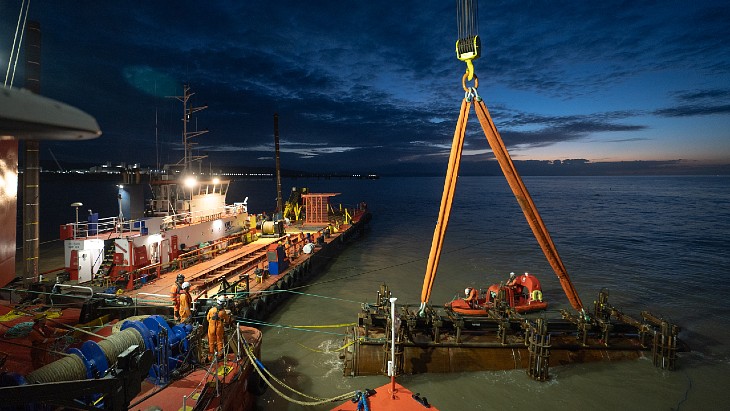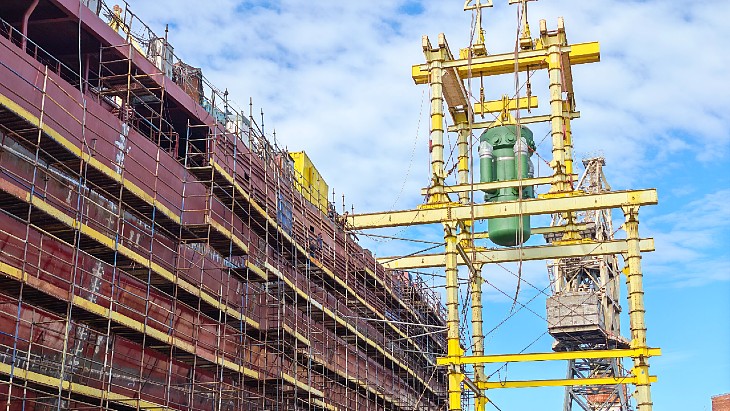
Each of the reactors weighs more than 147 tonnes, is 7.3 metres tall and 3.3 metres in diameter. Specialist lifting equipment was used to move them to their designated locations.
They are pressurised water reactors with the steam generators built into the core reactor vessel, which USC Baltic Shipyard says means that "unlike traditional designs with external steam generators, reduces the risk of coolant leaks, reduces the size and weight of the reactor, and simplifies installation and dismantling".
The reactors have a service life of 40 years, with seven years between refuelling. They have a thermal capacity of 175 MW, which converts to 30 MW at the propellers, and are designed to withstand 45-degree rolls (sideways tilting while at sea).
The keel-laying ceremony for the Leningrad took place in January 2024 and work on the hull and installation of equipment is continuing,
Background
There are currently a series of Project 22220 nuclear-powered icebreakers operating - the Arktika, Sibir, Ural, the Yakutia, plus the Chukotka, which has been undergoing mooring tests - and two under construction, the Leningrad and the Stalingrad at the Baltic Shipyard.
Within Rosatom's machine-building division, Afrikantov OKBM is the designer, complete supplier, and manufacturer of the reactor internals for the RITM-200 and RITM-400 reactor units. Reactor vessel fabrication and test assembly are performed at ZiO-Podolsk. Fifteen RITM-200 reactors have so far been completed, with 13 more under construction.
The Project 22220 vessels are 173 metres long, 34 metres wide and with a height from the waterline to the mainmast of 57 metres. They are designed to break through ice up to three metres thick and have a speed of 22 knots in clear water. The first four have been escorting cargo ships along the Northern Sea Route for several years now.
There is also a larger nuclear-powered icebreaker under construction, the Rossiya, which will be the first of the proposed Project 10510 nuclear-powered icebreakers. It will feature two RITM-400 reactors for a propeller power of 120 MW. It will be able to penetrate ice up to 4.3 metres thick and clear a channel up to 50 metres wide. It has a reported construction target service date of 2030.
Nuclear-powered icebreakers are a key part of Russia's plan to develop the Northern Sea Route, the shipping lane along its north coast which allows faster transport between Europe and Asia.


_51287.jpg)