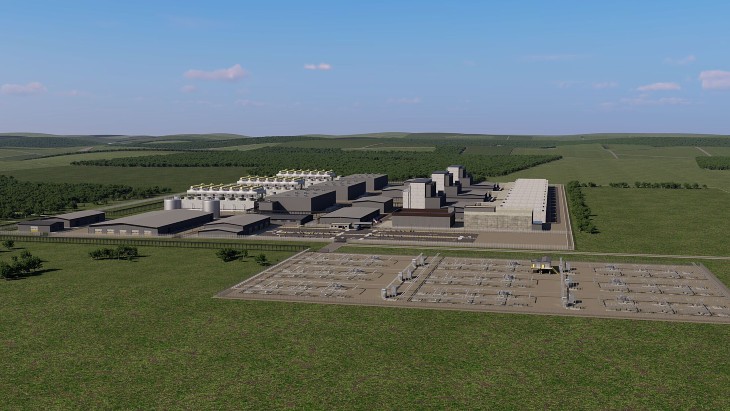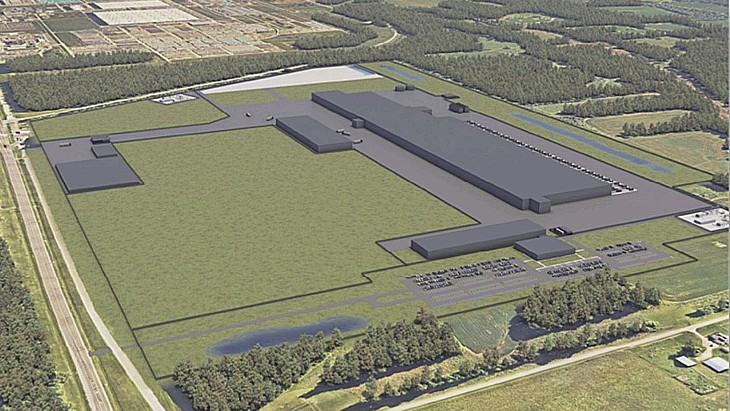
Global Laser Enrichment (GLE) submitted its Environmental Report for the Kentucky facility - also known as PLEF - to the US Nuclear Regulatory Commission (NRC) in December 2024. The Final Safety Evaluation Report - the last milestone before a licensing decision - is expected by the end of the year.
"The NRC's issuance of the Final Environmental Impact Statement represents a significant regulatory milestone for the PLEF and reflects the NRC staff's comprehensive and efficient review of our application," GLE Vice President, Safety, Security & Compliance Tim Knowles said. "We appreciate the agency's commitment to a rigorous, timely, and transparent licensing process."
GLE is the exclusive licensee of Silex Systems Ltd's SILEX laser enrichment technology for uranium. Last year, GLE took it to Technology Readiness Level 6, following the completion of a large-scale uranium enrichment demonstration programme using the technology at its Test Loop facility in Wilmington, North Carolina. As well as preparing for commercial deployment, GLE recently executed a long-term offtake agreement with Canadian company Cameco for future uranium enrichment production.
PLEF would deploy the technology to re-enrich high-assay depleted uranium tails from previous operations at the US Department of Energy's former Paducah gaseous diffusion enrichment plant. The plant will be the world’s first large-scale domestic enrichment facility utilising a next-generation enrichment process, GLE says, in a project that will strengthen US nuclear fuel cycle supply chains as well as supporting the nation's growing energy needs and enhancing long-term energy security.
Michael Goldsworthy, CEO and Managing Director of Silex Systems, said the PLEF licence is expected to be finalised in early 2027. "The issuance of the final EIS marks a significant step forward in GLE's mission to deploy the PLEF in the US, which would become the world's first laser-based enrichment facility for the production of natural grade uranium (from depleted uranium tails) and low-enriched uranium (LEU) with uranium-235 assays up to 5%. The NRC licence would also authorise GLE to produce LEU+ with assays up to 8% - which is a new fuel grade being sought by nuclear utilities to improve power plant economics," he added.
Background
Uranium-235 is the fissile isotope of uranium that is useful for energy production in a nuclear reactor - but this isotope only makes up about 0.7% of natural uranium. So for use in nuclear fuel, uranium can be "enriched" to increase the ratio of fissile uranium-235 to non-fissile uranium-238. Most commercial reactors currently in operation use low-enriched uranium - or LEU - fuel that is typically enriched to 3-5% uranium-235.
Today's commercially operating uranium enrichment capacity uses gas centrifuge technology, with centrifuges in which a fast-spinning rotor inside a vacuum casing makes use of the very slight difference in mass between the different uranium isotopes to separate them.
Laser enrichment processes are sometimes described as a third-generation technology. Precise wavelengths of light produced by lasers are used selectively to increase the energy of atomic or molecular species consisting of a specific isotope - a process called "laser excitation" - changing their properties and allowing them to be separated. The process has been described as substantially more efficient than existing methods of uranium enrichment, with potentially lower energy inputs, lower capital costs and lower tails assays.