_74315.jpg)
Under a technology agreement, KAERI will apply its existing research infrastructure and technical expertise to support Saltfoss's fuel development programme, including: pretreatment of fluoride molten salt for fuel-grade use; fabrication and characterisation of nuclear fuel; construction and operation of a natural-circulation molten-salt test loop; and corrosion evaluation of candidate reactor structural materials under high-temperature molten-salt conditions.
In this contract, KAERI will process molten fluoride salt into a state suitable for nuclear fuel manufacturing and use it to manufacture and evaluate nuclear fuel. Subsequently, to simulate the flow environment of the molten salt, KAERI will construct and operate a natural circulation test device in which the molten salt circulates with a temperature difference, and evaluate the degree of corrosion of structural materials exposed to high-temperature molten salt.
KAERI said the technology export contract with Saltfoss is worth about KRW3 billion (USD2.3 million). It said: "This technology export does not involve the transfer of ownership of existing molten salt reactor (MSR) source technologies or intellectual property held by the research institute, but rather is a method of providing research and development services by utilising the technology and research infrastructure held by the research institute."
"Korea continues to be a cornerstone of our strategy, and this agreement with KAERI is a natural next step in that relationship," said Klaus Nyengaard, CEO of Saltfoss, formerly known as Seaborg. "KAERI's depth of experience with molten-salt fuel and materials is exactly the kind of proven, real-world expertise we want alongside our own team as we move the seaMSR-100 toward certification. It's a strong signal of confidence in our technology from one of the world's leading nuclear research institutes."
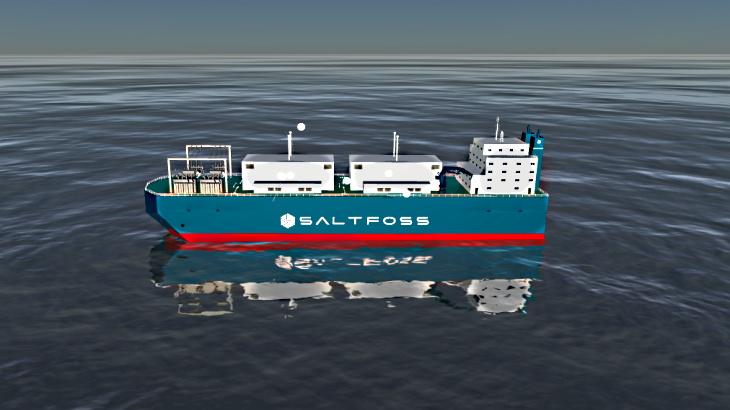
A rendering of a Saltfoss Power Platform (Image: Saltfoss)
In May 2024, KAERI and Seaborg signed a memorandum of understanding to advance nuclear technology. Both organisations said they recognise the critical role of nuclear power in a carbon-neutral future and have been working independently on advanced nuclear systems, especially MSRs. The MoU set the stage for both parties to combine their research and development strengths, enhancing their capabilities and driving innovation in nuclear technology.
Saltfoss said the agreement is the latest step in its continued progress and close collaboration with South Korea, home to Saltfoss Korea and a long-standing partnership with Samsung Heavy Industries on the seaMSR-100's floating MSR platform. "Together with KAERI's fuel and materials expertise, and decades of experience handling high-temperature molten salts, this work strengthens Saltfoss's supply chain and technical foundation as the company moves toward regulatory certification and deployment of its floating power plants," it said.
"This contract is a significant achievement in which Korea's original MSR technology, secured through national R&D, has been recognised for its technical value by a foreign private company," said KAERI Acting Director Im In-cheol. "We will further expand the development of core technologies and international cooperation so that our technology can secure competitiveness in the next-generation MSR market, which will be utilised at sea and on land, and enter the global market."
MSRs use molten fluoride salts as primary coolant, at low pressure. They may operate with epithermal or fast neutron spectrums, and with a variety of fuels. Much of the interest today in reviving the MSR concept relates to using thorium (to breed fissile uranium-233), where an initial source of fissile material such as plutonium-239 needs to be provided. There are a number of different MSR design concepts, and a number of interesting challenges in the commercialisation of many, especially with thorium.
Saltfoss's seaMSR-100 is an MSR delivering 100 MW electric or 250 MW of high-temperature thermal power. Several reactors can be integrated on a single Saltfoss Power Platform, providing 100-600 MWe or 250-1,500 MWt, or a combination of the two through cogeneration. Each reactor operates for 24 years without refuelling, ensuring simple operation and predictable performance throughout its life cycle. Operating at about 650°C and near-atmospheric pressure, the seaMSR-100 leverages the unique properties of molten salt for both heat transfer and fuel containment.


_33441.jpg)
_17445.jpg)
_18654.jpg)