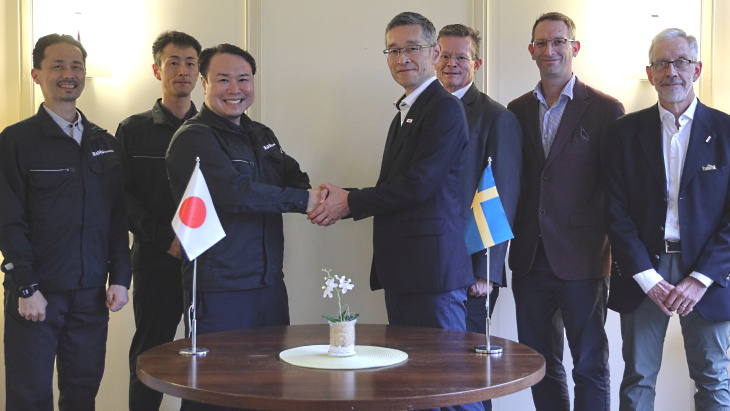
Under an agreement signed on 21 October, ReNu will design a pilot plant - to be built in Fukushima Prefecture - adapted to Japan's seismic and regulatory requirements and to the characteristics of the waste to be treated.
Studsvik's inDRUM technology is a solution for transuranic (TRU) waste streams that have characteristics that do not meet waste disposal criteria. The technology can be used on low, intermediate and high-level radioactive wastes.
inDRUM is a batch thermo-chemical system that treats containerised radioactive wastes by means of in-container thermal treatment to remove the free liquids, destroy organics, and deactivate corrosives and reactive materials from the containers. Treatment is achieved without removing or handling/sorting wastes from the container. In most applications, wastes are treated in the container in which the wastes were originally packaged. The thermally decomposed waste form is an inert, inorganic dry char (ash-like substance), significantly reduced in volume (as much as 90%).
The inDRUM process consists of two main treatment systems: an electrically-heated container treatment vessel (CTV), where thermal treatment of drums is performed, followed by an off-gas treatment system that oxidises any volatile organic compounds, carbon monoxide, and traces of hydrogen volatised from the CTV and removes and/or neutralises any acid gases, mercury or iodine present in the off-gas stream.
ReNu has been awarded up to JPY700 million (USD4.4 million) under the Subsidy for Projects Promoting Practical Development for Regional Reconstruction, implemented by Fukushima Prefecture under the Japanese government's Fukushima reconstruction initiative, to develop a radioactive waste treatment pilot plant in Fukushima. ReNu aims to establish the basic design conditions for the Japanese version of inDRUM during fiscal year 2026, which ends in March 2027, and, subject to the necessary agreements, to complete the pilot plant in fiscal year 2028.
Studsvik operates a full-scale inDRUM demonstration facility in Nyköping and is advancing the adoption of inDRUM for the treatment of radioactive waste from the European Spallation Source (ESS) in Lund.
The partnership with ReNu is the first step in the model Studsvik has chosen for taking inDRUM to international markets. Studsvik will build and operate its own inDRUM facilities in Sweden, while abroad it will license the technology and work with local partners that design, build and operate the plants. In September 2023, Studsvik and German radioactive waste specialist GNS Gesellschaft für Nuklear-Service mbH formed a strategic and exclusive cooperation to implement Studsvik's inDRUM technology for the German market.
Building on the Fukushima project, Studsvik and ReNu will explore deploying inDRUM elsewhere in Japan and in Asia, as well as broader cooperation in nuclear engineering, including fusion.
"Fukushima will need radioactive waste treatment for decades," said Studsvik President and CEO Karl Thedéen. "ReNu is based in Okuma, the town that hosts the plant, and brings the local knowledge needed to adapt inDRUM to Japanese conditions. Fukushima is our starting point in Japan and in Asia."
ReNu CEO Ryohei Takahashi added: "Decommissioning Fukushima requires technology proven around the world, re-engineered to fit Japan's regulations and site conditions and implemented with local hands. Through our technical collaboration with Studsvik, ReNu will adapt inDRUM to Japanese regulatory and site requirements. We intend to build on our experience in Fukushima to pursue opportunities elsewhere in Japan and overseas."