_85200.jpg)
In the USA, commercial nuclear power plants are initially licensed by the Nuclear Regulatory Commission (NRC) to operate for up to 40 years. A first licence renewal covers an additional 20 years for an operating lifetime of 60 years, and subsequent licence renewals cover a further 20 years of operation beyond that, focusing on the management of plant ageing during the 60-80 year operating period.
The renewed operating licence for Clinton unit 1 - a 1,062 MWe (net) boiling water reactor (BWR) that was connected to the grid in April 1987 - expires in April 2047. The licences for Dresden 2 (an 894 MWe BWR connected to the grid in April 1970) and unit 3 (an 879 MWe BWR grid connected in July 1971) now expire in December 2049 and January 2051, respectively.
Constellation said it is investing more than USD370 million to re-licence the plants, installing state-of-the-art upgrades "to increase efficiency and ensure safety and reliability for decades to come".
At Clinton, two new auxiliary transformers and two advanced equipment chillers are delivering higher system reliability, while upgrades to the plant's condensate polisher system offer greater protection from component degradation, the utility said. At Dresden, operators are now using next-generation feedwater level control technology to enhance reactor safety, while a new main power transformer purchased for the plant will deliver state-of-the-art electrical system monitoring and control. "With these and other upgrades in place, Clinton and Dresden continue to operate at higher levels of safety, reliability and efficiency than the day they came online," Constellation said.
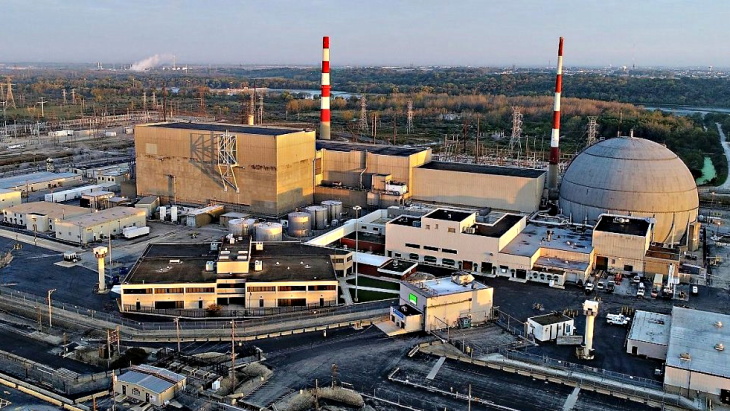
Dresden (Image: Constellation)
"In the last ten years, we've invested over USD3 billion in our high-performing Illinois nuclear facilities to power the state's economy with clean, reliable energy," said Constellation Executive Vice President and Chief Generation Officer Bryan Hanson. "These licence extensions will allow Clinton and Dresden to stay online for another two decades, preserving more than 2,200 family-sustaining jobs and USD8.1 billion in federal, state and local tax dollars."
However, the utility noted that while these licence renewals give it the regulatory approval needed to operate Clinton and Dresden for another two decades, "actual operation is contingent on each plant's financial viability". At Clinton, it said, the facility's carbon-free energy is secure as a result of the 20-year agreement with Meta announced in August. The deal supports the continued operation, expansion and relicensing of the plant following the expiration of the state's Zero Emission Credit programme in May 2027.
"With today's decision to renew the operating licences for Clinton unit 1 and Dresden units 2 and 3, the NRC has now approved 20-year extensions for 13 reactors this year," said Jeremy Groom, acting director of the NRC's Office of Nuclear Reactor Regulation. "This milestone reflects our continued focus on improving efficiency in the licence renewal process, while upholding the NRC's high standards for safety and security. Equally important, these renewals help ensure that safe, reliable, and carbon-free electricity continues to supply our nation's electric power grid. Together, these units will generate more than 12 gigawatts of electricity over the next two decades, enough for nearly 10 million homes across the country."


_1_12560.jpg)
_55462.jpg)


_84289_33276.jpg)