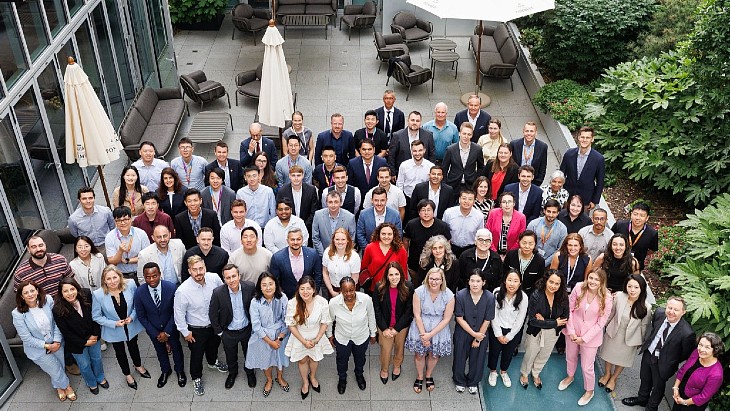
Speaking at World Nuclear Association's World Nuclear Symposium in London, Ma said the ambition for the world to triple nuclear energy by 2050 was clear, but the challenge would be on delivery.
State Nuclear Power Technology Corporation is a subsidiary of the State Power Investment Corporation (SPIC), and is involved in design, standardisation and fleet-based construction.
With China having the largest construction programme in the world - with 58 units currently under construction and a target of 150 GW capacity by 2035 - he said their experience had found four major challenges which needed to be met - "to deliver many projects in parallel, safely, on schedule and on budget" which was "a question for everyone" involved in the sector.
The first was design, where, he said, there was a need to "strike the right balance between fixing a standardised design and continuing to improve the technology. A design that changes too frequently disrupts construction, while a design that never changes will become outdated. Finding that balance is the first test of high-quality fleet-based construction".
The second challenge was to ensure the supply chain can match demand - the risk was that "long-lead critical equipment supply cannot match the scale of project demand ...These constraints can make it difficult to build multiple units in parallel and deploy our reactor series at scale."
The third area was management. "Managing one project is hard, managing many at once is harder. We need standardised management models that are replicable, and that reach deep into construction and installation," he said, as well as needing coordination of people and equipment across parallel commissioning programmes.
The fourth area of challenge he highlighted was the need to ensure "specialised talent development" was able to keep up with project growth. "Certified nuclear-grade welders and non-destructive testing technicians are in short supply, which constrains equipment manufacturing and construction progress alike."
He said that none of these challenges can be solved by a single project or a single company and "they are the common test of our industry" at scale.
On engineering and procurement, he said their practice was to have a standardised design with integrated feedback from construction, commissioning and operation. There is a Design Change board which "reviews every change through tiered approval" and their target was to have a "standard design reuse ratio" of above 80%.
On procurement, they consolidate orders from multiple projects to allow centralised procurement as well as having reactor-specific industrial chains and an "early warning mechanism for supply chain risk", with a backup plan for high-risk items. Their key target was to have a more than 93% first-time pass rate of equipment acceptance.
On construction, there is standardised management organisation, "with fixed-price contracts and strict control of project boundaries and design changes, and AI and digital tools that make construction less labour intensive ... and modular construction will optimise the work sequence, connecting design, procurement, construction and commissioning end-to-end".
He said that: "Through these measures we are working towards a 56-month construction schedule with a first-time pass rate of 95% for key processes."
On commissioning, he said "we have adopted a commissioning model led by the EPC contract with deep owner involvement ... which reaches 40% to 50% on new projects and 50% to 60% on expansion projects,". There was also a "cross-project commissioning manpower matrix" and "two-tier tools and equipment pooling and deployment across sites".
He said these all helped a fleet-based construction system which was "reliable, transferable and sustainable".
In conclusion, he said: "For our industry, fleet-based construction is no longer a choice - it's a question we must all answer and it's the surest bridge from ambition to action. SNPTC looks forward to working with partners around the world on technical standards, supply chain resilience, talent development and smart construction to turn the grand vision for our industry into reality."


_55605.jpg)