_82983.jpg)
In October 2024, the US Department of Energy (DOE) - under the Joe Biden administration - opened applications for funding to support the initial domestic deployment of Generation III+ small modular reactor (SMR) technologies, with up to USD800 million to go to two "first-mover" teams, with an additional USD100 million to address so-called gaps that have hindered plant deployments. According to the solicitation documentation, a Gen III+ SMR is defined as a nuclear fission reactor that uses light water as a coolant and low-enriched uranium fuel, with a single-unit net electrical power output of 50-350 MWe, that maximises factory fabrication approaches, and the same or improved safety, security, and environmental benefits compared with current large nuclear power plant designs.
The solicitation was re-issued by the DOE in March this year to better align with President Donald Trump's agenda on unleashing American energy and AI dominance.
The DOE has now announced the selection of Tennessee Valley Authority (TVA) and Holtec as the first-mover recipients of funding to advance initial Gen III+ SMR projects.
"The selections announced today will help deliver new nuclear generation in the early 2030s, strengthen domestic supply chains, and advance President Trump's Executive Orders to usher in a nuclear renaissance and expand America's Energy Dominance agenda," the DOE said.
"President Trump has made clear that America is going to build more energy, not less, and nuclear is central to that mission," said US Secretary of Energy Chris Wright. "Advanced light-water SMRs will give our nation the reliable, round-the-clock power we need to fuel the President's manufacturing boom, support data centres and AI growth, and reinforce a stronger, more secure electric grid. These awards ensure we can deploy these reactors as soon as possible."
The projects
TVA's application was selected for funding to accelerate the deployment of the USA's first Gen III+ SMR at its Clinch River site in East Tennessee. TVA - which applied for the grant with a coalition of partners in April - plans to advance deployment of a GE Vernova Hitachi BWRX-300 at the site, as well as accelerate the deployment of additional units with Indiana Michigan Power and Elementl. Additionally, TVA plans to work with the domestic nuclear supply chain partners Scot Forge, North American Forgemasters, BWX Technologies, and Aecon. Other partners supporting the project include Duke Energy, Oak Ridge Associated Universities, and the Electric Power Research Institute. TVA says the Clinch River project will serve "as a national model for how to deploy SMRs safely, efficiently, and affordably".
In May, TVA submitted a construction permit application to the US Nuclear Regulatory Commission (NRC) to build the first BWRX-300 at Clinch River. The NRC is currently reviewing the application.
"This award affirms TVA's continued leadership in shaping the nation's nuclear energy future," said TVA President and CEO Don Moul. "With DOE's support and the strength of our partners, we're accelerating the deployment of next-generation nuclear – reducing financial risk to consumers and strengthening US energy security. This is how we deliver reliable, affordable energy and real opportunity for American families."
As the lead applicant, TVA and DOE will now enter further discussion around project milestones and co-applicant awards.
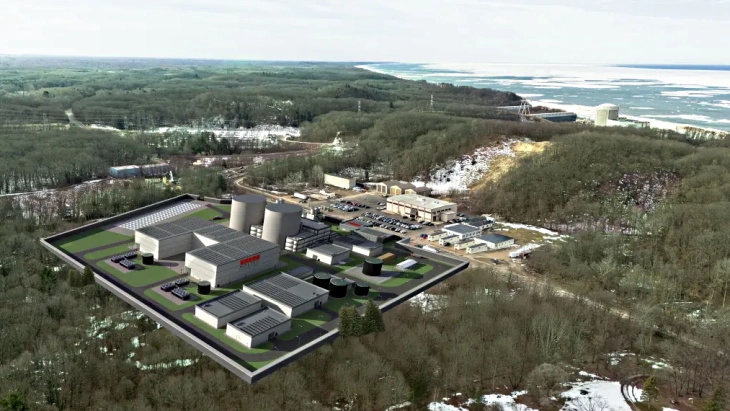
The planned Palisades SMR project (Image: Holtec)
Holtec plans to deploy two SMR-300 reactors - named Pioneer 1 and 2 - at the Palisades Nuclear Generating Station site in Michigan, demonstrating viability for additional orders both domestically and abroad. Holtec is pursuing an innovative one-stop-shop approach to SMR deployment by fulfilling the roles of technology vendor, supply chain vendor, nuclear plant constructor in partnership with Hyundai Engineering & Construction, plant operator, and electricity merchant selling the power to nearby utilities and end-users. Holtec's proposal includes a multi-site deployment pathway that establishes a repeatable, fleet-scale model - a core requirement of the Tier 1 programme intended to drive down costs and shorten construction durations through standardisation and manufacturing efficiency. The Pioneer reactors are planned to be brought online in the early 2030s.
"Holtec realises the future of nuclear energy as a source of reliable baseload electricity to power the economy of the future is realised only if we, in the industry, make the reactors predictably cost competitive," said Kris Singh, CEO and Executive Chairman of Holtec International.
"With a well-exercised and proven supply chain, a world-class alliance partner, Hyundai E&C, and the plant design marinated with four decades of practical corporate experience, we consider it our duty to lead the industry in building, owning, and operating the first SMR-300 plant in the United States. We are energised by DOE's confidence in our SMR-300 reactor, which we view as validation of our 14-year quest to develop a walk-away-safe and cost-competitive nuclear reactor. This grant positions Holtec to accelerate deployment of a standardised SMR-300 fleet that strengthens US energy security and grid resilience and will further bolster Holtec as one of the largest US exporters of nuclear equipment."
DOE said the remaining USD100 million in funding under the programme will be awarded later this year to support additional deployments and address key barriers in design, licensing, supply chain, and site readiness.


_76412.jpg)
_38809.jpg)
_15774.jpg)
_29250_15814.jpg)