_90576.jpg)
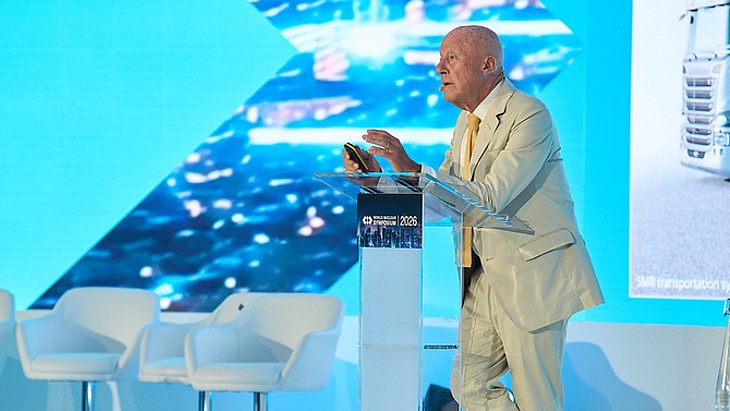
Opening the session on fusion energy at the conference earlier this month, Tristram Denton, UK Director of the Washington, DC-headquartered Fusion Industry Association, said global private investment in fusion has reached between USD10 billion and USD15 billion over the past seven to eight years, alongside more than USD5 billion in public funding worldwide.
He characterised the trajectory as "a very significant wave", adding that "we are on the way for real significant commitment to fusion energy." Denton also highlighted the UK's position as a leading public investor in proportional terms, noting that as a share of GDP, the UK currently spends more on fusion than any other country.
He pointed to the government's recent strategy publication in March as a key milestone, saying it provides "a strong reflection of what industry has been asking for", including clearer pathways for large-scale government programmes and frameworks intended to enable private-sector development and supply chain growth.
Industrial applications and new system concepts
From the private sector, Oded Gour-Lavie, CEO and co-founder of Israel-based nT-Tao, argued at the conference, held on 11 June, that fusion was increasingly being viewed not simply as a fuel substitution technology, but as a systemic shift in energy architecture. He described growing demand from sectors such as data centres, maritime operations, and water treatment, where continuous 24/7 power supply was critical. "A small compact system can help," he said, framing fusion as a potential enabler of decentralised, resilient energy infrastructure rather than only a grid-scale replacement.
Gour-Lavie also emphasised the importance of manufacturability and scale, stating that the industry's objective must be "mass production and really bring it to market as fast as possible". He noted that regulatory distinctions emerging in some jurisdictions between fusion and fission technologies could support faster pathways to deployment, while highlighting the importance of international collaboration due to lower proliferation concerns compared with conventional nuclear systems.
UK technology development and STEP momentum
On the UK technology front, David Kingham, founder and senior advisor at Tokamak Energy, outlined progress on high-temperature superconducting magnet systems and compact spherical tokamak development.
Kingham said the company, founded in 2009, had raised around USD350 million and employs more than 300 staff, with its ST40 device achieving plasma ion temperatures of 100 million degrees Celsius — a benchmark widely viewed as relevant to commercial fusion conditions. The system is now being used as a testbed for next-generation technologies, including advanced microwave heating systems.
He also confirmed Tokamak Energy's role in the UK government's STEP programme, including a GBP70 million (USD94 million) contract to develop magnet systems through to 2029.
In October 2022, the West Burton coal-fired power plant site in Nottinghamshire, England, was selected to host the UK's Spherical Tokamak for Energy Production (STEP). The demonstration plant is expected to cost in the region of GBP20 billion and is due to begin operating by 2040. The technical objectives of STEP are: to deliver predictable net electricity greater than 100 MW; to innovate to exploit fusion energy beyond electricity production; to ensure tritium self-sufficiency; to qualify materials and components under appropriate fusion conditions; and to develop a viable path to affordable lifecycle costs. As well as the STEP fusion facility, a skills centre and a business park are planned.
Engineering, supply chains and national industrial strategy
From an engineering and infrastructure perspective, Peter Roberts, Director for New Build and Fusion at nuclear engineering firm Nuvia, said fusion was now moving beyond theoretical demonstration into "early-stage delivery", with real programmes, infrastructure planning and industrial foundations taking shape.
He stressed that fusion development would require a broad industrial ecosystem spanning advanced manufacturing, digital engineering, construction, and materials science. Roberts also highlighted the importance of supply chain development, noting that UK initiatives such as STEP are already acting as catalysts for industrial capability growth and regional investment.
However, he cautioned that significant technical and organisational challenges remain, particularly around sustained power generation, system integration, and long-term operational reliability. "Leadership is not guaranteed," he said, emphasising the need for sustained policy support and coordinated action across government and industry.
Regulation and investor confidence
Regulatory readiness was also highlighted as a key enabler for investment. Tokamak Energy's Kingham noted that the UK has positioned fusion under the oversight of the Environment Agency and the Health and Safety Executive, following a structured risk assessment concluding that fusion facilities present hazards comparable to established industrial sites such as chemical processing plants and oil refineries.
This approach, speakers argued, provides greater certainty for investors and supports the UK's positioning as a favourable jurisdiction for fusion development.
Outlook: from research to deployment
Closing remarks from Denton emphasised the need for system-wide coordination across industry, government, insurers, and regulators as the sector prepares for industrial scale-up.
He said current efforts were focused less on first-principles research and more on "scaling up manufacture, scaling up capability to deliver", and building the institutional frameworks needed for deployment.
While fusion remains a long-term endeavour, speakers broadly agreed that the combination of increasing capital flows, maturing technology programmes such as STEP, and a structured regulatory environment marks a shift toward what several described as the "pre-deployment phase" of the industry.


_76412.jpg)
_38809.jpg)
_15774.jpg)
_29250_15814.jpg)