According to the published announcement in the Federal Register, a categorical exclusion is "a category of actions that the agency has determined, as established in its agency NEPA (National Environmental Policy Act) procedures, normally does not significantly affect the quality of the human environment and therefore does not require preparation of an environmental assessment or environmental impact statement".
The announcement is in line with executive orders issued in May 2025 which said "decades of research and engineering have produced prototypes of advanced nuclear technologies that incorporate passive safety mechanisms, improve the physical architecture of reactor designs, increase reactor operational flexibility and performance, and reduce risk in fuel disposal. Advanced reactors - including microreactors, small modular reactors, and Generation IV and Generation III+ reactors - have revolutionary potential".
The US Department of Energy (DOE) says its categorical exclusion covers advanced nuclear reactors as long as the DOE determines that "the project's attributes, including potential fission product inventory, fuel type, reactor design, and operational plans, reduce sufficiently the risk of adverse offsite consequences from the release of radioactive or hazardous materials, and the project demonstrates that any hazardous waste, radioactive waste, or spent nuclear fuel generated by the project can be managed in accordance with applicable requirements".
The department will still review whether a particular project meets the exclusion criteria and whether "extraordinary circumstances exist such that a normally excluded action may have a significant environmental effect". In further commentary it says that "adverse consequences of the construction phase of advanced nuclear reactors are primarily related to the extent of land disturbance necessary to construct the facility footprint and are analogous to construction of non-nuclear industrial facilities. DOE will consider the construction impacts in accordance with applicable requirements (such as land use and zoning requirements) in the proposed project area".
Summarising the reasoning for its decision, the DOE says that "advanced nuclear reactors have key attributes such as safety features, fuel type, and fission product inventory that limit adverse consequences from releases of radioactive or hazardous material from construction, operation, and decommissioning. Although past advanced reactor projects have been for solely experimental, testing and demonstration purposes, the advanced fuel forms, inherently safe designs, and inventories of potential fission products associated with these reactors indicate that reactors in this category developed for additional purposes, such as power production and industrial applications, are also appropriate for this categorical exclusion".
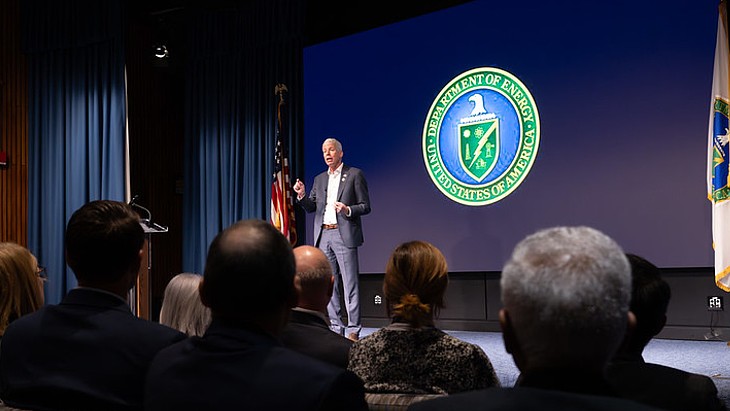
The document was signed by Energy Secretary Chris Wright on 28 January, and the DOE is soliciting comments on the changes for 30 days from the date of publication, which was 2 February.


_80308_74311_79560.jpg)
_55605.jpg)