According to the US Department of Commerce, the location of the new units has yet to be specified, with USD100 billion "slated for construction costs (overnight costs) and USD20 billion for contingency reserves. These reserves are counted toward the investment amount".
In its description of the 'Project Power' scheme, it says that the eight units would be part of achieving the US president's goal of having 10 large reactors under construction by 2030.
The Department of Commerce says: "By combining US technological expertise with Korea's supply chain capabilities and leveraging successful deployment cases in the United States, the two parties will broaden their strategic, long-term cooperation in the global nuclear power market. The parties will develop and announce individual projects separately as sites, schedules, and commercial terms are finalised. Both countries have agreed to cooperate on transferring a USD10 billion advance payment by the end of the year to facilitate efforts, which are aimed primarily at the immediate purchasing of long-lead items, in accordance with all applicable domestic legal requirements."
The announcement also said that there would be a "significant minority equity investment" in Westinghouse by "Korean Companies (TBD)... details will be finalised at a later date".
In a post on the social media site X, Westinghouse Nuclear said the "agreement between the United States and South Korea marks a defining moment for American nuclear energy and the longstanding partnership between the two countries. Westinghouse is proud to bring our deep engineering expertise, proven innovation and global experience needed to deploy advanced reactor technology in the US and around the world - strengthening energy security and advancing a more reliable energy future".
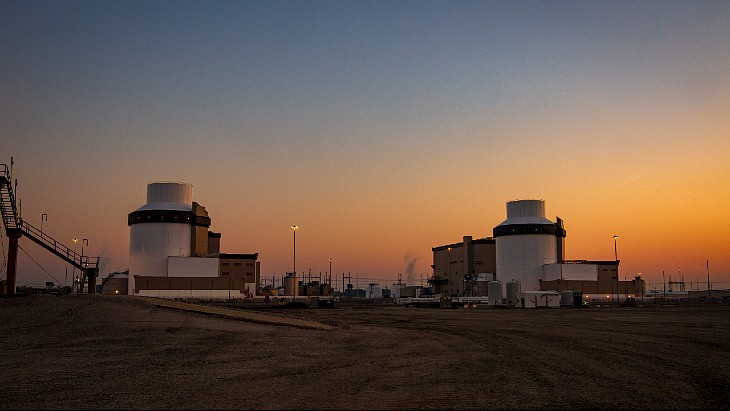
Cameco, which owns 49% of Westinghouse, said that the framework agreed by the two governments would see the new units being deployed on federal sites, beginning with two AP1000 units.
In its statement, Cameco also said the agreement "contemplates a waiver under the 2025 settlement agreement reached by Westinghouse in its intellectual property dispute with Korea Electric Power Corporation and Korea Hydro & Nuclear Power Co., Ltd. The one-time waiver would allow for the construction of up to two APR1400 reactors in the United States, generating enhanced value for Westinghouse. The associated compensation package is expected to recognise the use of Westinghouse intellectual property and technology, providing approximately USD2 billion of value per APR1400 reactor through a combination of intellectual property licensing, engineering and procurement services, subcontracting opportunities and the long-term supply of fuel fabrication services, highlighting the strategic role that Westinghouse is expected to play across the contemplated reactor projects in the US".
Referring to the potential equity investment by South Korean firms in Westinghouse, Cameco said it "does not expect any potential equity participation contemplated under the Framework to affect our ownership interest in Westinghouse".
Tim Gitzel, CEO of Cameco, said: "We are pleased to see the US government continuing on a path to expanding nuclear power capacity in the US. Cameco remains focused on supporting the US government's objective of quadrupling US civil nuclear capacity by 2050, using the industry-leading, fully licensed, generation III+ AP1000 reactor.
"Our priority continues to be on the Department of Energy's American Nuclear Supply Chain Loans conditional commitment, under which AP1000 reactor construction timelines are expected to accelerate by as much as three years, along with the strengthening of the nuclear supply chain. New orders for AP1000 reactors, such as those envisioned by this Framework, represent an excellent opportunity to further derisk and accelerate the rapid buildout of the AP1000 fleet around the world."
Korea Electric Power Corporation (KEPCO) welcomed the framework agreement, which it says reaffirms the 2025 US-Korean memorandum of understanding on strategic investment.
It said: "The establishment of a framework for Korea-US nuclear cooperation is expected to become a new milestone in energy cooperation between the two countries. KEPCO plans to contribute to the successful implementation of related projects based on the experience accumulated through the domestic power industry and the UAE Barakah nuclear power project.
"Furthermore, the entry of the Korean-designed APR1400 into the US market is expected to showcase the technological prowess and project management capabilities of our nuclear industry and contribute to the entry of domestic nuclear companies in the US market and the expansion of their participation in global supply chains."


_42437.jpg)
_76412.jpg)
_38809.jpg)