In January 2024, the British government launched a roadmap for reaching its ambition for the UK to have 24 GWe of nuclear generating capacity by 2050, representing about 25% of the country's projected electricity demand. It said the Civil Nuclear Roadmap "outlines plans for the biggest expansion of nuclear power for 70 years to reduce electricity bills, support thousands of jobs and improve UK energy security - including exploring building a major new power station and investing in advanced nuclear fuel production". Nuclear's share of energy in the UK is currently about 16%, however all but one of its existing reactors are due to be retired by 2030.
In June 2025, Rolls-Royce SMR was selected as the UK government's preferred technology for the country's first small modular reactor (SMR) project. In November, the UK government announced that Wylfa on the island of Anglesey, North Wales, would be the site to host the three Rolls-Royce SMR units. It said the site - where a Magnox plant is being decommissioned - could potentially host up to eight SMRs. A final investment decision is expected to be taken in 2029.
The deployment of SMRs and advanced modular reactors (AMRs) to provide power for data centres and industrial parks, and for the production of clean fuels and hydrogen, is also being discussed at other locations within the UK, including the deployment of Holtec International's SMR-300 at the former Cottam coal-fired power plant in Nottinghamshire, England, to provide power to new, advanced data centres on the site.
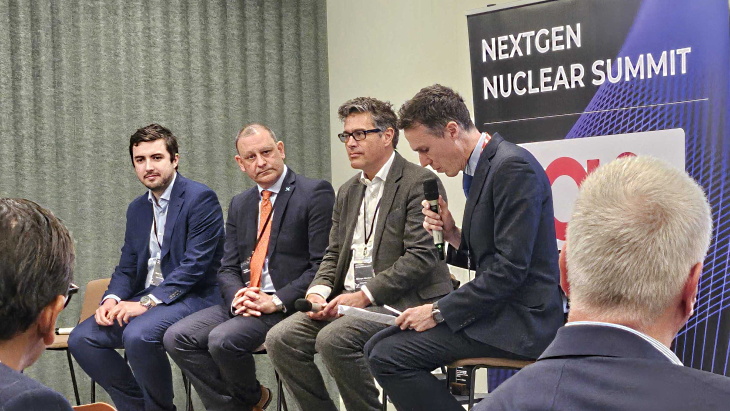
Speakers at the one-day event, organised by Foresight Events, highlighted what is needed to get to the first-of-a-kind construction of SMRs and AMRs in the UK and their eventual large-scale fleet deployment.
Lord Ravensdale, vice-chair of the Nuclear Energy All Party Parliamentary Group, said that one of the barriers to new nuclear in the UK was planning and regulation. "It's not just about nuclear - it's common to all large infrastructure projects in the UK. The planning and environmental permitting of infrastructure - we really struggle in the UK at the moment ... we need to work hard to remove those barriers to enable us to build all kinds of large infrastructure, including nuclear." He said there were a couple of bills coming up in parliament - the Energy Independence Bill and the Nuclear Regulatory Bill. "We're going to be focusing on all of these processes to ease through large infrastructure projects in the system."
In its final report (the 'Fingleton Report'), published in November, the Nuclear Regulatory Taskforce - led by John Fingleton, former CEO of the Office of Fair Trading - said a "radical reset" was needed and outlined 47 recommendations for the government to speed up building new nuclear projects at a lower cost and on time.
Rob Mossop of nuclear strategic and technical consultancy and project development company Equilibrion said: "From my perspective, government and the associated organisations around the government need to start delivering on the Fingleton Report as soon as possible and meet the deadlines and meet the recommendations. I think we need to start seeing a little bit more movement in that area as soon as possible."
In the USA, TerraPower started construction on its first Natrium plant, Kemmerer unit 1 in Wyoming, in April. The company's Natrium 345 MWe sodium-cooled fast reactor has a molten-salt-based energy storage system which allows it to temporarily boost output to 500 MWe when needed, enabling the plant to follow daily electric load changes and integrate with fluctuating renewable resources. The Natrium reactor is a TerraPower and GE Vernova Hitachi Nuclear Energy technology. In February the Natrium reactor was accepted into the UK's Generic Design Assessment process.
Speaking at the event, Jeff Miller, Senior Vice President of Business Development at TerraPower, said: "We've been through the regulatory process in the United States. We have a construction permit under 10 CFR Part 50, which means we have the permission for nuclear concrete. So, we are reflecting on that and how to be better and more efficient in navigating that process and taking those lessons over here and leveraging the Nuclear Regulatory Commission and Office for Nuclear Regulation relationship to hopefully be as accelerated as we possibly can."
Scaling up for fleet deployment
Leon Flexman, Corporate Affairs Director at X-energy, said: "If the government is doing the right things to get things going, then the baton is handed on to us to deliver. When we get to that point where we can see a programme of projects that are being delivered, then everybody can rally around that and start to scale up, whether that's skills, supply chain, investors, etc."
He added: "I think one of the things that we need to make sure we do next in order to both deliver projects successfully, but also to deliver them successfully for the UK, is to make sure that the supply chain can rise to the challenge. So, if you look at what happened in our experience in the US, there are ... [many] different SMRs and AMRs out there. And the supply chain needs to ramp up to be ready to deliver. But who does the supply chain pick as the horse that it wants to back if it's going to require investment and staffing up and qualifying to compete, etc? It wasn't really until we got Amazon on board in the US with that pipeline of 5 GW of projects that the supply chain thought, 'right, OK, now this is real, and we need to actually take this seriously'. And as a result, we're making great strides over there. We need to do the same thing in the UK."
The UK is emerging from decades of little new nuclear construction. Simon Barber, UK Managing Director of Assystem, said: "Now we actually have to scale up, and that scaling up is constrained by a number of factors: Firstly, there's a lack of continuity between projects. We've already seen the gap between Hinkley Point C and Sizewell C starting - which means that there is a kind of desert or a fallow area where the skills that we're developing from Hinkley Point C, we run the risk of losing some of those skills because the gap when they're needed for Sizewell City is just too big. So, we need that continuity, that drumbeat of projects that's really going to deliver value and allow the UK to build with the skills it desperately needs. For me, what's at the heart of that is a real lack ... of a cohesive industrial strategy that puts nuclear at its heart, that focuses on the skills that we need to build and actually has that drumbeat, that mandate to build nuclear at pace and at scale."
Responding to a question on how to break the perception that the first-of-a-kind projects are too expensive, too slow, and too bespoke, Andrew Howarth, Vice President of Strategy at the UK's National Nuclear Laboratory, said: "I think to get to first-of-a-kind, you absolutely do not want to be doing research and innovation, but let's use what we know and is regulated and validated and get across the line. But I think in parallel with that, we could be doing validation and testing of things that could be introduced later on to second-, third-, fourth-of-a-kind, which could bring costs down and not much by design changes ... So, I think there's a kind of twin-track approach of validation and testing that goes on in parallel with first-of-a-kind that helps bring that kind of certainty and risk down from a technological perspective."
On the fuel supply side, Sarah Forman, Head of Strategy and Corporate Development at uranium enrichment services provider Urenco, noted that traditionally its customers have been the large utilities running Generation Three reactors. However, she said, "we're now increasingly serving the next generation of nuclear that we're talking about today. And we're one of these fuel cycle companies that needs to scale up in tandem with everybody else, all stepping up a level so that we can be ready for this opportunity to return. We're doing that. So, a lot of this is around changing our investment strategy and growing. Right now across our four different sites in the UK, Germany, the Netherlands, and the US, we have big investment projects to increase our enrichment capacity".
She added: "There's a really big opportunity for governments to send a powerful signal that gives the certainty for that investment in a different context. It's really about government standing up and saying very clearly that nuclear is going to be part of our energy mix for a very long time. It makes sense to invest in this, and it makes sense to support it so that you can have a changed approach that lets us all be ready to support each other."
"There's a lot of work to do to really maximise that opportunity and invest in those missing pieces of the puzzle in the nuclear fuel supply chain, like conversion and actually fabrication of advanced fuels as well, really so we can get our whole capability in the UK and, again, seize those export markets," Lord Ravensdale said.
Kevin Murray of Frazer-Nash Consultancy said advanced nuclear technologies were "attracting unprecedented levels of attention from right across the ecosystem, from government, from investors, industry, and off-takers ... the challenge really facing the sector is all about moving from the proving of the technological feasibility, which is very much in train, towards the practical realities around that long-term fleet deployment. There are around 70 technologies in development globally. But really, survival of the fittest is which of those technologies are most likely to reach commercial cooperation first".


_29695_19459.jpg)
_98552.jpg)
_1_12560.jpg)
_22582.jpg)


_84289_33276.jpg)