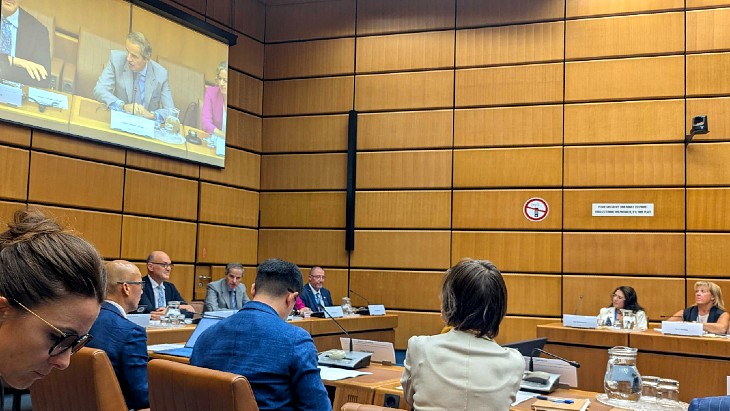
Details of the White Paper on the Facilitation of the Safe and Secure Transport of Radioactive Material, which was prepared by the International Atomic Energy Agency (IAEA)'s Denial of Shipment Working Group, were presented at a side event at the IAEA's 70th General Conference
There are more than 20 million packages needing to be transported each year, and IAEA Director General Rafael Mariano Grossi told the packed meeting that although there had been progress with the issue, it "continues to present challenges internationally. Denials and delays are subtle but extremely negative things that continue to happen" even with "companies in countries that are in favour of the transportation. So there is a problem in communication, which should not exist. I think it's high time we really tackle this issue in a concerted way, in a coherent way and try to solve it as much as we can".
Why the issue matters
Canadian Ambassador to Austria and Permanent Representative to the International Organisations in Vienna, Alison Grant, said: "Delayed shipment can mean delayed cancer treatment, postponed diagnostic scans, disrupted industrial operations, interrupted research activities … we need transport systems that recognise the importance of reliable access to radioactive material for all peaceful applications and we need better international cooperation."
King Lee, Head of Policy and Industry Engagement for World Nuclear Association - whose Programme Lead - Fuel Cycle, Allarakha Vora, has been involved in the working group - said that the industry was actively supporting, as needed, measures to tackle the issue. He stressed in particular the fundamental importance of transport throughout the nuclear fuel cycle, and praised the revival of the national focal point system (where each country has an identified expert point of contact to help resolve issues).
Peter Bryant, outgoing CEO of the World Nuclear Transport Institute, told the event: "When we talk about a shipment being unnecessarily delayed or denied, we need to think about what is at the other end of that journey - it could be a patient waiting for treatment, it could be an industrial facility needing to inspect a critical component, it could be technology helping to keep food safe or reduce food waste, or it could be material supporting the generation of low-carbon energy. We are not simply facilitating the transport of radioactive material. We are facilitating the benefits that the nuclear radioactive material provides to society."
The White Paper
The working group, which was established for a four year duration and is due to hold its final meeting later this year, finalised the White Paper in April, and it has now been published and shared with IAEA member states.
The paper says that the main causes of delays and denial of shipment are: perception and cultural factors; awareness gaps; regulatory complexity; lack of harmonisation and administrative gaps; insurance and economic barriers; and carrier and logistics issues.
The main consequences are listed as: negative impact on patient healthcare; increased costs and resource use; operational delays leading to safety or security risks; and regulatory non-compliance risks.
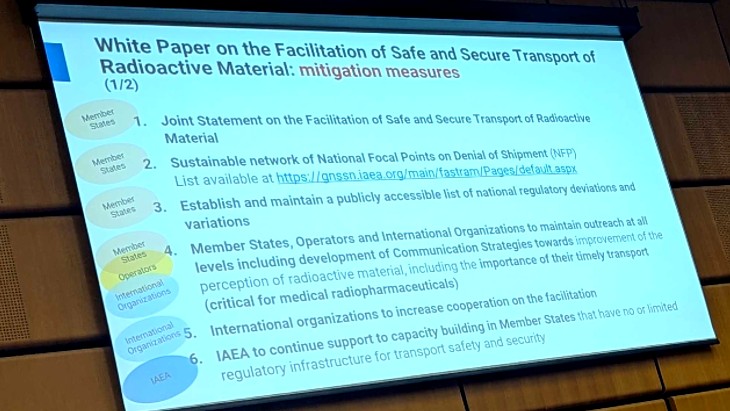
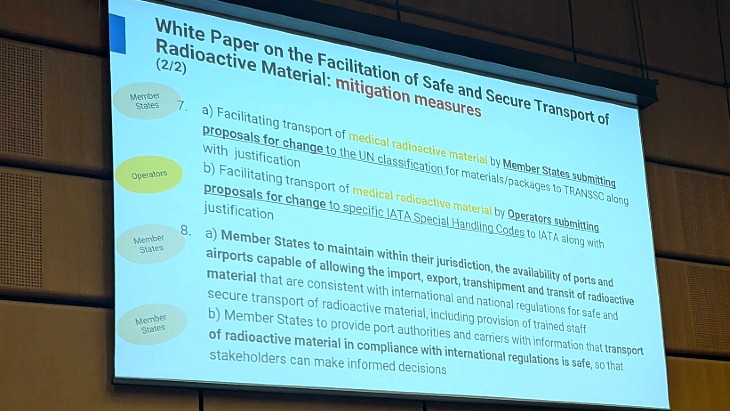
Its eight mitigation measures were set out during the meeting, as shown in these two photos:
(Image: WNN)
(Image: WNN)
As shown on the left-hand side of the above photos, the meeting was given an indication of the most relevant stakeholder - member states, operators and industry and international organisations - for the various proposed mitigation measures.
What next?
At its final working group meeting in December, its members will "discuss and refine the governance framework to maintain collective oversight of facilitation, to continue addressing the denial of shipment issue, with shared ownership and responsibility for a sustainable approach".
The meeting was told that responsibility increasingly rests with member states - "the key actors driving the call for solutions to take decisive, harmonised and sustained actions. The issue cannot be entirely eliminated, but the impacts of denial of shipment can significantly be reduced, as per the proposals of the White Paper".
Grossi assured the meeting of the IAEA's continuing support.
The IAEA maintains a list of National Competent Authorities for the Safe Transport of Radioactive Material and also a list of the 75 National Focal Points appointed worldwide as of August 2026.


_76412.jpg)
_38809.jpg)
_15774.jpg)
_29250_15814.jpg)