The plant is designed to process 3.6 million tonnes of ore annually, and is expected to add about 500 tonnes of metallic uranium production capacity annually, the company says, significantly improving the utilisation of the mine's resources.
The Husab mine is owned and operated by Swakop Uranium, a partnership between Namibia and China: 10% of the company is held by the Namibian state-owned Epangelo Mining Company and 90% by Taurus Minerals which is itself majority owned (60%) by China General Nuclear (CGN). Development of the mine began in 2013, and production began in 2016. By 2025, production had ramped up to about 4600 tU against a design capacity of about 5100 tU per year, according to information from World Nuclear Association, with most of this being supplied to China and up to 20% being marketed internationally by CGN Global Uranium.
Husab contains abundant low-grade granite-type uranium ore resources - it is described by the OECD Nuclear Energy Agency and the International Atomic Energy Agency, in their latest report on uranium resources and production (known as the Red Book) as the world's largest operating open-pit uranium mine by physical scale, investment size and operational footprint. In 2024 it accounted for 7% of global production, according to World Nuclear Association.
But due to geological characteristics such as dense ore structure and poor permeability, uranium leaching rates at Husab are low and seepage effects are poor, according to CGN. This makes traditional leaching processes - where crushed ore is stirred, typically with sulphuric acid, to extract uranium - economically inefficient, and has meant that a large amount of Husab's low-grade resources have remained "dormant" for a long time, CGN said.
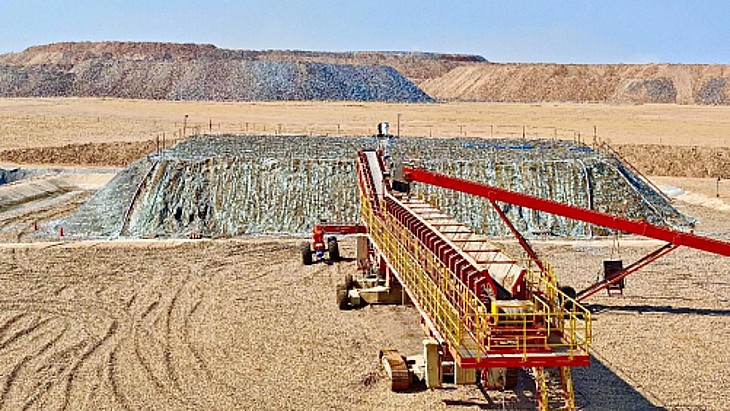
Heap leaching is a method that can be used for very low-grade uranium ore. Instead of stirring, the broken ore is stacked about 5 to 30 metres high on an impermeable pad and irrigated with acid.
Research and development work into the potential use of heap leaching began at Husab in 2013, leading to the development of innovative ways of using technology to precisely control the acid-base range of the leachate, and overcoming technical bottlenecks, CGN said. After bench and pilot scale tests, the project team ultimately determined the optimal process parameters for crushed high-rise stacks with particle sizes less than 8 millimetres and heights of 9 metres. The development process included the implementation of more than 30 technological optimisations and upgrades and multiple new patents, and saw the achievement of an 82% leaching rate which CGN says is approaching the level of traditional stirring leaching processes.
"Reaching this stage has taken years of research, planning and teamwork," Swakop Uranium CEO Luo Wei told Namibian news publication New Era. "Our focus now is on delivering it safely and responsibly, while ensuring the benefits extend beyond the mine to the wider Namibian economy," he added.
According to the government-owned newspaper, the R&D and trial phases represented an investment of some USD20 million and created around 200 jobs. The cost of the commercial heap leach plant, and an additional acid plant, is estimated at around USD300 million with commissioning expected by the end of 2027.
According to World Nuclear Association's information paper on China, the country currently has 58 operable reactors providing capacity of 56.93 GWe, with a further 32 reactors under construction and dozens more at the planning or proposed stage. It aims to produce one-third of the uranium it needs domestically, obtain one-third through foreign equity in mines and joint ventures in other countries and to purchase the remaining one-third on the open market.