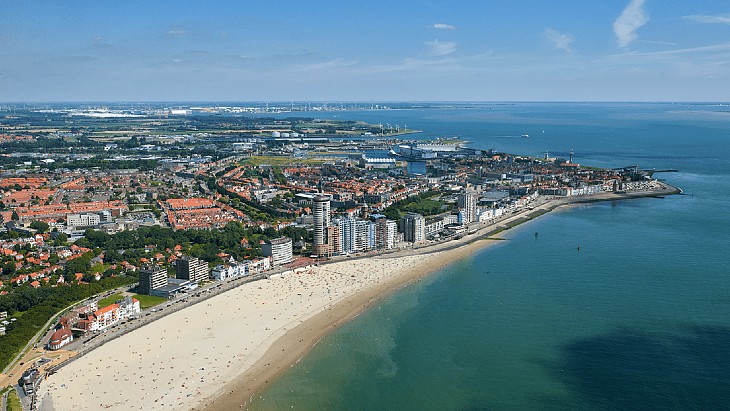
The SMR Zeeland 2050 study was carried out by Tractebel and Haskoning in collaboration with Impuls Zeeland and Smart Delta Resources.
The report was commissioned because the region, home to one of the largest industrial clusters in the Netherlands, sees small modular reactors (SMRs) as providing a sustainable and reliable energy supply and potential process heat for industry and hydrogen production.
Deputy Jo-Annes de Bat said: "With this study, we are exploring how and whether SMRs can contribute to Zeeland as a green energy source in the future. This study gives us direction to be prepared for different scenarios."
The study suggests that commercial deployment would happen around 2035-2040, and says that while companies are positive, "the government must take the lead to make this a reality".
It recommends a phased approach with the Province of Zeeland focusing in 2026/2027 "on organising cooperation between public and private parties, updating the environmental and energy vision, and starting location surveys". This would be followed by technical preparations, feasibility studies and the streamlining of permit processes, as well as the further development of education, skills and training.
The study says that from 2029 Zeeland could "take an active role in the realisation of SMR projects or support market initiatives. In this way, the province ensures that it is ready for all scenarios".
The study says that the exploration of the potential for SMRs in the region is separate from the on-going project for selecting potential locations for new nuclear units in the country and is "not an alternative or replacement for it".
Existing nuclear power
The Netherlands has one 485 MWe (net) pressurised water reactor at Borssele - operated by EPZ - which has been in operation since 1973 and accounts for about 3% of the country's total electricity generation. It is scheduled to close in 2033, but the government has requested it remain in operation until 2054, if this can be done safely.
A previous policy of phasing out nuclear energy was reversed in December 2021 by the then new coalition government, which placed nuclear power at the heart of its climate and energy policy. In addition to keeping the Borssele plant in operation for longer, the government also called for the construction of new reactors. Based on preliminary plans, two new reactors will be completed around 2035 and each will have a capacity of 1000-1650 MWe. The two reactors would provide 9-13% of the country's electricity production in 2035. The cabinet announced in December 2022 that it currently sees Borssele as the most suitable location for the construction of the new reactors. Three other locations are also being considered for the reactors: the Tweede Maasvlakte near Rotterdam, Terneuzen in Zeeland and Eemshaven in Groningen. The government is also taking steps to prepare the Netherlands for the possible deployment of SMRs.


_22748.jpg)
_29250.jpg)