The announcement comes shortly after the US Department of Energy approved the Nuclear Safety Design Agreement for Antares's first electricity-producing reactor, known as Mark-1.
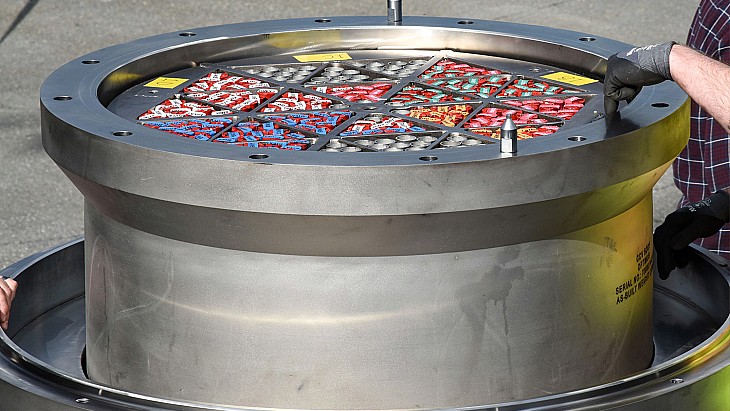
Under the agreement with BWXT Advanced Fuels, the fuel will be fabricated from high-assay low-enriched uranium (HALEU) at BWXT's facility in Lynchburg, Virginia, on the fabrication line that made the fuel for Antares's Mark-0 reactor when it reached its criticality milestone earlier this year. The same line has also fabricated fuel for the US Department of War's Project Pele microreactor.
TRISO - for tri-structural isotropic - fuel encases a uranium kernel in layers of carbon and ceramic that contain fission products at very high temperatures - a property that Antares says allows its reactors to be compact, transportable, and inherently safe.
BWXT's decades of experience in advanced fuel manufacturing give it the foundation to support Antares as it moves towards commercial deployment, Joe Miller, President of BWXT Government Operations, said. "Our team has refined the processes for high-performance TRISO fuel, and this agreement enables us to apply those strengths in a sustained, predictable way. As demand grows across the advanced reactor sector, BWXT is prepared to scale," he added.
"We achieved criticality with BWXT fuel, and it's what will power our electricity-producing reactor, Mark-1, in 2027," Antares CEO and co-founder Jordan Bramble said. "Securing that same line through the end of the decade means our first production deployments run on fuel from a team and a process we've already proven."
The agreement means that Antares now has two qualified sources for the fuel for reactor deployments: in August, Standard Nuclear announced an agreement to deliver a minimum of 1 tonne and up to 8 tonnes of TRISO fuel to Antares in the period to 2035. The company has also this year signed a HALEU contract with US enrichment company Centrus, as well as one with European-headquartered Urenco for HALEU to be produced at a facility currently under construction at Capenhurst in the UK.
Licensing milestone
Antares's Mark-0 was the first reactor to go critical by the 4 July deadline set by US President Donald Trump when the microreactor completed a zero-power fuelled criticality demonstration at Idaho National Laboratory in June. Mark-1 will be the company's first electricity-producing reactor. Antares has also been selected by the US Army for deployment at Fort Bragg, North Carolina, as part of the Department of War's Janus Program. A May 2025 executive order from US President Donald Trump has called for an Army-regulated nuclear reactor at a domestic military installation to be in operation by 30 September 2028.
The Department of Energy's approval of the Nuclear Safety Design Agreement - or NSDA - for Mark-1 was announced by Antares on 23 October. This is the first step in the department's authorisation pathway, establishing the design requirements, safety analysis approach, and regulatory expectations that will govern the reactor through construction and operation.
"Mark-0 proved we could take a reactor from a paper design to a self-sustaining chain reaction on the timeline we promised," Bramble said. "Mark-1 isn't a scaled-down, stand-in test rig. It's commercially representative of the plant we'll deploy to Fort Bragg under the Army Janus programme in 2028. Mark-1 will be the first full-scale electricity-producing microreactor test in the United States. Operating at full electrical power for six months gives us comprehensive test data on every major subsystem and how they behave together. DOE's approval of this safety agreement is the gate that lets us move not only from neutrons to electrons, but to customer plants, on schedule."