More than 27 hectares of land were reclaimed and the volume of tailings material transported exceeded 1.4 million cubic metres, Rosatom said. In total, during nine years of the programme four sites in the village of Min-Kush in the Naryn Region and one near Kadji-Sai in the Issyk-Kul Region have been rendered "radiation-safe", it added.
Specialists from Russia's state nuclear corporation consolidated and transported radioactive waste from the Tuyuk-Suu and Taldy-Bulak sites to the centralised tailings storage facility, Dalneye. "The facility itself underwent extensive technological modernisation. It was equipped with multi-layer insulating protective screens and modern drainage systems, guaranteeing complete safety and resistance to any natural disasters and landslides," Rosatom said.
Kyrgyzstan's Minister of Emergency Situations, Kanatbek Chynybaev, said: "The successful completion of the reclamation project in Min-Kush is a historic step for the environmental safety of all of Central Asia. Thanks to the synergy between our agencies and the state-of-the-art technology of the Rosatom State Corporation, we have eliminated a threat that has troubled our citizens for decades. Areas that once raised serious concerns due to the threat of mudflows and landslides are now fully restored and are returning to safe economic use. We greatly appreciate the support of the Russian Federation, which has provided 75% of the funding for this programme."
Rosatom Director General Alexey Likhachev said: "I sincerely congratulate you on the successful completion of the first stage of rehabilitation work in the Kyrgyz Republic. Thanks to this work, facilities in the villages of Min-Kush in the Naryn Region and Kadji-Sai in the Issyk-Kul Region have been brought to a radiation-safe condition."
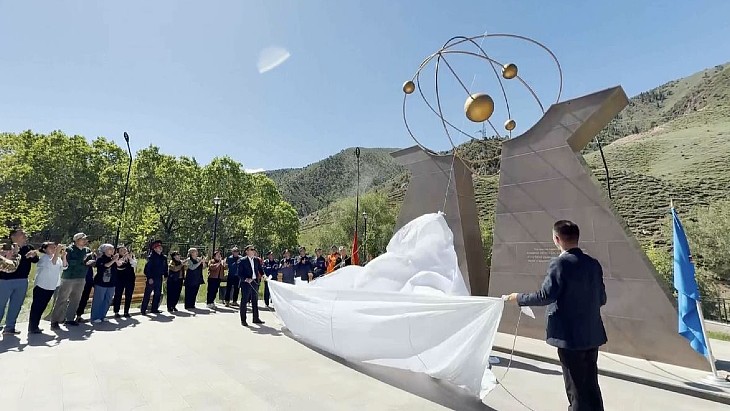
During the event the two sides approved a joint action plan for "implementing bilateral cooperation in the area of territorial rehabilitation for 2026-2028". A monument was also unveiled in Min-Kush to the country's mining history "and contribution to the USSR's atomic project", Rosatom said.
As well as the completed work to make the uranium tailings dumps radiation-safe, "the current stage involves the rehabilitation of three mine waste dumps, their shafts, and structures in the southern regions of the republic, scheduled to run until 2030. The Russian government has allocated omore than 2 billion rubles for these activities. Work has already been completed at two sites - Too-Moyun in the Osh region and Kyzyl-Zhar in the Jalal-Abad region", Rosatom added.
Background
Central Asia served as an important source of uranium for the former Soviet Union. Uranium was mined for more than 50 years and uranium ore was also imported from other countries for processing, and large amounts of radioactively contaminated material were placed in mining waste dumps and tailing sites. Most of the mines were closed by 1995 but very little remediation was done before or after the closure of the mining and milling operations. The contaminated material is a threat to the environment and the health of the population. The hazards include the possible pollution of ground and surface water in a key agricultural centre of the region.
The IAEA Coordination Group for Uranium Legacy Sites (CGULS) supports countries to safely manage these sites and the residues of radioactive and toxic contaminants to protect people and the environment. Since 2012, CGULS has supported Central Asian countries with practical guidance on remediation strategies, expert missions to guide progress in remediation efforts, and assisted in capacity building and developing legal and regulatory frameworks for remediating legacy sites.
In 2017, the Strategic Master Plan for Environmental Remediation of Uranium Legacy Sites in Central Asia, which focuses on Kyrgyzstan, Tajikistan and Uzbekistan, was adopted by the IAEA, the European Commission, the European Bank for Reconstruction and Development (EBRD) and the Commonwealth of Independent States Economic Council, as well as the governments of Kyrgyzstan, Tajikistan and Uzbekistan, to establish a strategy and concrete mechanisms to remediate the sites safely and sustainably. The plan - published in May 2018 - identifies seven former uranium production sites in the region as the highest priority: Mailuu-Suu, Min-Kush and Shekaftar in Kyrgyzstan; Degmay and Istikol in Tajikistan; and, Charkesar and Yangiabad in Uzbekistan. The total cost of remediating the seven sites was estimated at around EUR85 million (USD99 million). A revised Strategic Master Plan (SMP) was signed in September 2021.
The latest Strategic Master Plan was presented in Tashkent, Uzbekistan, in October 2025, and will guide the future activities of the IAEA, international organisations and collaborating countries, focusing on monitoring, maintenance, record keeping and continuous stakeholder engagement towards the safe and beneficial use of the remediated land.



_55605.jpg)


_18654.jpg)