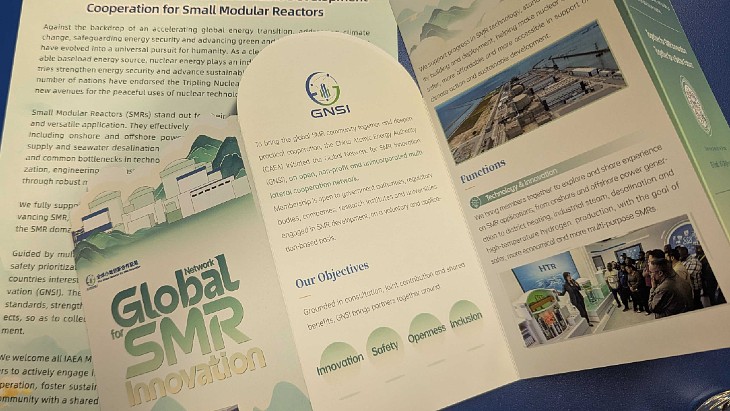
In an event to promote the launch of the initiative at the 70th IAEA General Conference in Vienna, the message was that small modular reactors (SMRs) "are expected to play a critical role in the global expansion of nuclear energy", with a wide range of uses beyond electricity generation, such as offshore power, high-temperature hydrogen production, district heating and desalination.
The meeting was told that the technology, regulatory, economic and supply chain challenges require multinational cooperation and collective efforts.
The organisers of the Global Network for SMR Innovation (GNSI) stressed that the "non-profit, unincorporated and open cooperation mechanism" would complement the International Atomic Energy Agency, with all membership voluntary and open to government departments, regulatory bodies, companies, research institutes and universities.
Structurally, it will have a governing board, a secretariat, specialised committees and working groups. The first general assembly and inaugural conference is scheduled for the end of this year, attendees were told. All members will be bound by confidentiality, with intellectual property ownership "determined through consultation".
The event featured speakers from a range of Chinese enterprises involved in SMR development, including the ACP100 - also known as the Linglong One - the first of which is currently being commissioned on the island of Hainan. This has a rated power of 125 MWe, a 24-month refuelling schedule, a 58-month construction timeline and requires a land area of 20.6 hectares. There was discussion also of the Guohe series, including the Gen 3+ GH300 and the GH200T, which would be 200 MWt or 50-60 MWe.
In addition, there was an overview of the HTR-PM, a pebble bed modular high temperature gas-cooled reactor (HTGR), and a proposal that the new initiative could facilitate the sharing of practical HTGR experience in design, construction and operation as well as "enhance communication on safety regulation and technical standards and deepen industrial collaboration with joint R&D, supply chain cooperation and talent development".
CGN said its "key driver" was the 200 MWt HuaPeng-1 integral natural circulation pressurised SMR, which would have an estimated construction timeline of 36 months and need a site area of 10 hectares. It would provide global partners with "deployment-ready SMR products and offer end-to-end project services and open R&D for scenario-specific SMR development.
The event heard from representatives of Pakistan, Thailand and Nigeria about their support for the project and the opportunities for cooperation in the potential development of SMRs and SMR projects.
Deputy Director General of the International Atomic Energy Agency Huang Wei noted the agency's latest projection for future nuclear energy capacity - which could lead to as many as 1,000 SMRs globally by 2060 - and said the agency was "pleased to see China taking proactive steps to build a favourable level playing field for nuclear energy to release its full potential. The launch of this Global Network for SMR Innovation by China will further reinforce the IAEA's activities and efforts in strengthening international cooperation on SMRs".


_1_12560.jpg)
_55462.jpg)


_84289_33276.jpg)