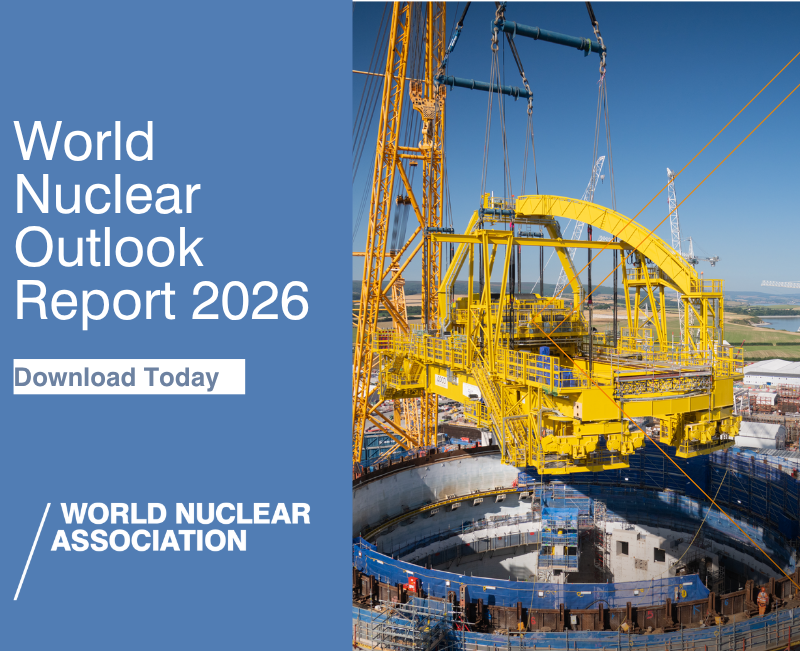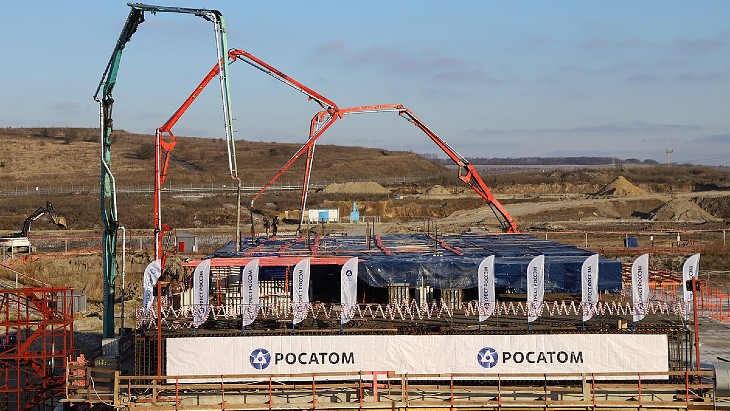
About 200 workers were involved in the pouring of concrete to form the 5,400-square-metre slab, a process which took four months, said Rosatom, Russia's state nuclear corporation. It added that throughout the process there was "multi-level quality control, with specialists monitoring dozens of important parameters daily".
Alexander Khazin, Project Director for the Construction of Power Units 3 and 4 at Kursk II, said: "Completing the concrete pouring of the reactor building's foundation is a crucial stage of construction, after which the installation of reinforced concrete blocks and the concrete pouring of the main power unit building's walls will begin. Next, specialists will begin erecting the reactor building's walls."
Another key event this year for the project - for which the International Atomic Energy Agency lists construction as starting on 31 January - is set to be the installation of the first elements of the reactor building's internal containment shell.
Kursk NPP Director Alexander Uvakin said: "The safety and stability of any facility, especially one as complex as a nuclear power plant, depends on its foundation. I express my gratitude to the team, whose experience, collaboration, and hard work enabled us to complete yet another key task as part of one of the nuclear industry's leading projects at a high level and ahead of schedule."
Background
Kursk II is a new nuclear power plant in western Russia, about 60 kilometres (37.5 miles) from the Ukraine border, that will feature four of the new VVER-TOI reactors, the latest version of Russia's large light-water designs. They have upgraded pressure vessels and a power rating of 1,250 MW.
Construction of the first unit began in 2018, its polar crane was installed in October 2021 and the reactor vessel was put in place in June 2022. Concreting of the outer dome of the first unit was completed in August 2023. It was commissioned at the end of last month. The second unit is also under construction and the target is for all four units to be in operation by 2034.
Rosatom says the service life of the main equipment has doubled, and that the VVER-TOI units feature a mix of passive and active safety systems and include a core meltdown localiser. The new units at Kursk II will replace the four units at the existing, nearby Kursk nuclear power plant, which are scheduled to shut by 2031.
The first unit was shut down after 45 years of operation in December 2021 and the second unit followed in January 2024. The original design life for the four RBMK-1000 reactors at the plant was for 30 years but had been extended by 15 years following life extension programmes.


_76412.jpg)
_38809.jpg)
_15774.jpg)