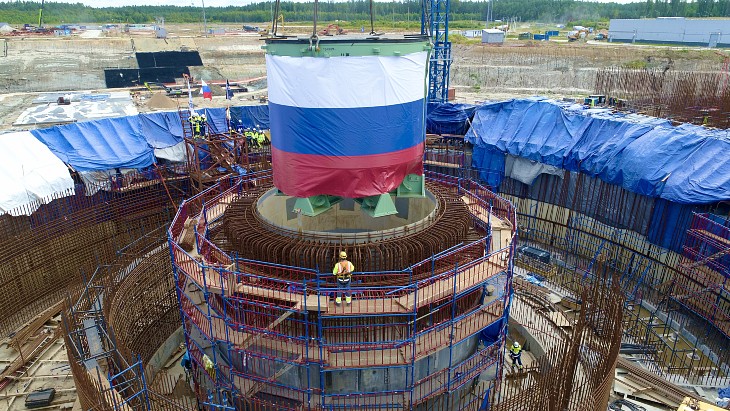
The core catcher, also known as a melt trap, is a key bit of safety equipment. It is a container in the form of a cone made of thermally resistant steel which in the event of an emergency is designed to securely hold the melt of the core and not allow radioactive substances to leave the containment of the reactor.
The installation of the core catcher at the unit, which is also known as Leningrad II-4, took eight hours to complete.
Valery Zhemchugov, Acting Director of the Leningrad NPP, said: "This is a significant event for our site. Firstly, the core catcher is the first large-scale component of VVER-1200 Unit 4 and the first passive safety system to be installed. Secondly, we completed this key operation almost three months ahead of schedule, in full, and in compliance with all quality requirements. Thirdly, this gives us additional time not only to stay on schedule but also to build on this success and intensify construction and installation work on the reactor building - the most complex and critical facility at the unit."
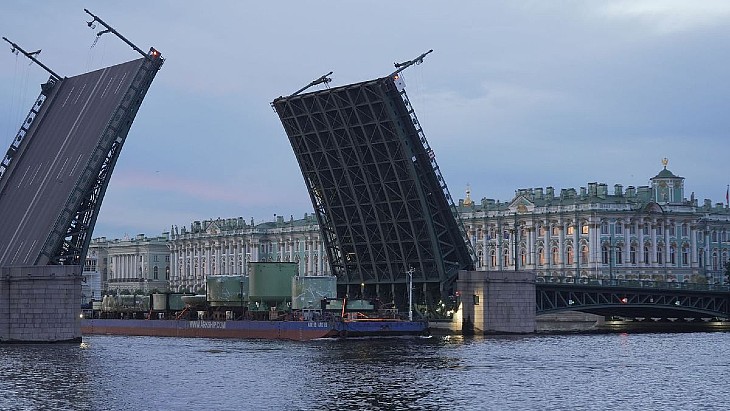
The core catcher had a 2,000 kilometre journey by boat to the site (Image: Rosatom)
According to Rosatom - Russia's state nuclear corporation - installing the core catcher means preparations can begin for the reactor vessel assembly, which is scheduled for 2029. It says that work continues to construct the double containment building and "to install the reactor building's floors and other internal structures, and install equipment for various process and safety systems".
Background
The Leningrad nuclear power plant is one of the largest in Russia, with an installed capacity of 4,400 MWe, and provides more than 55% of the electricity demand of St Petersburg and the Leningrad region, or 30% of all the electricity in northwest Russia.
Leningrad 1 shut down in 2018 after 45 years of operation. Leningrad 2, also a 1,000 MWe RBMK unit, started up in 1975 and was permanently shut down in November 2020. As the first two of the plant's four RBMK-1000 units shut down, new VVER-1200 units started up at the neighbouring Leningrad II plant. The 60-year service life of these fifth and sixth units (also known as Leningrad II-1 and Leningrad II-2) secures power supply until the 2080s, with the possibility of a further 20-year extension beyond that. Units 7 and 8 (also known as Leningrad II-3 and Leningrad II-4) will replace units 3 and 4 as they are shut in the coming years.
The pouring of the first concrete for unit 7 in March 2024 marked the start of the main phase of construction of the new power unit. The core catcher was installed in June this year. First concrete was poured for the eighth unit in March 2025.


_29695_19459.jpg)
_98552.jpg)
_1_12560.jpg)
_22582.jpg)