_29176.jpg)
The US Department of Transportation's Maritime Administration (MARAD) and Core Power (US) Inc announced their signature of a non-exclusive Memorandum of Cooperation to collaborate on maritime nuclear frameworks in Washington DC on Monday. It follows a recent Request for Information from the maritime administration for a commercially viable, system-centric approach to nuclear power in the US marine transportation system.
The framework links the US Maritime Action Plan - released in February following on from April 2025's Executive Order 14269, Restoring America’s Maritime Dominance - with allied shipbuilding and specialist US nuclear integration, Core Power said. The Action Plan has a three-pillar strategy aiming to rebuild an industrial base the Administration has identified as central to economic and national security, and "re-establish" the USA as a global maritime power.
Nuclear propulsion "changes the basic operating model" for commercial shipping, according to Core Power, which is developing an industrial platform for fleet-scale maritime nuclear infrastructure. A reactor provides sustained high power for years between refuelling and avoids dependence on conventional marine fuel supply, while eliminating emissions from propulsion. "The commercial task is to build a complete system that is safe, secure, licensable, insurable, financeable and operable at fleet scale, with clear responsibilities for nuclear integration, fuel, ports, workforce and through-life support," the company says.
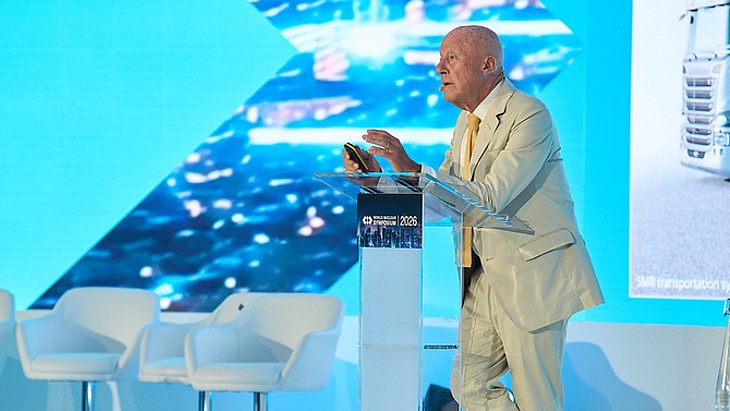
Globally, commercial shipbuilding today is dominated by China - and China is already moving toward nuclear-powered commercial shipping, a fact which should "focus minds in Washington". Core Power founder and CEO Mikal Bøe said.
"The United States has seven decades of nuclear-at-sea experience, world-class allies and the nuclear expertise to lead the next generation. Japan and Korea can accelerate conventional ship construction while America builds the specialist nuclear-grade integration and lifecycle capability at home - capability that can also strengthen the wider maritime industrial base.
“We are not asking for another study. Core Power is targeting first construction starts from 2028. Government can set the direction and coordinate; private industry must move the money and the steel. We are honoured to be working with MARAD on this landmark programme."
The agreement signed by Core Power and the Department of Transportation's Maritime Administration aims to turn policy into an actionable commercial pathway, creating a forum for government, industry and other stakeholders to work through regulatory acceptance, port operations, workforce credentialling, fuel and lifecycle services, insurance and finance, industrial capacity and potential federal demand structures. Reducing uncertainty across these areas will enable private capital to commit to ships, yards and supporting infrastructure, Core Power said.
The company said it plans to develop a dedicated US nuclear-grade integration and lifecycle shipyard for nuclear installation, initial fuelling, testing, commissioning, refuelling, defuelling and "through-life" support. Conventional hulls and marine systems will be built at commercial shipyards, leveraging allied shipbuilding capacity to accelerate conventional hull construction while building the specialist nuclear integration and lifecycle capability in the United States.
"President Trump has made it clear that American energy dominance and maritime strength go hand in hand," Stephen Carmel, Administrator of the Maritime Administration, said. "This framework ensures that the United States leads the world with a secure US-flagged fleet. Nuclear propulsion is a serious commercial opportunity, but it must be approached as a complete system - safe, secure, licensable, and investable."
The announcement came ahead of the launch of the International Atomic Energy Agency's Atomic Technologies Licensed for Applications at Sea (ATLAS) initiative, which aims to "support the maritime industry's exploration of small modular reactors to power civilian ships and to provide offshore energy, as operators consider alternative fuels and seek to strengthen long-term energy security". The IAEA ministerial launch event, hosted by the US, is taking place on Wednesday and Thursday in Washington DC.


_51287.jpg)