The Maritime Administration (MARAD) launched an initiative in May to develop small modular reactors (SMRs) for use in commercial shipping. As a first step, the agency issued a Request for Information, calling on innovators and industry stakeholders to help develop an SMR model that "revitalises US shipbuilding, cuts costs, and secures energy dominance". MARAD - whose mission is to foster, promote and develop the USA's maritime industry to meet the country's economic and security needs - noted the SMR initiative advances President Donald Trump's Executive Orders on Unleashing American Energy and Restoring America's Maritime Dominance.
Last month, the Port of Long Beach in California - one of the busiest container ports in the USA - signed a memorandum of cooperation with MARAD, making it the first US seaport to formalise a partnership with the Maritime Administration to establish nuclear-powered vessels for commercial service.
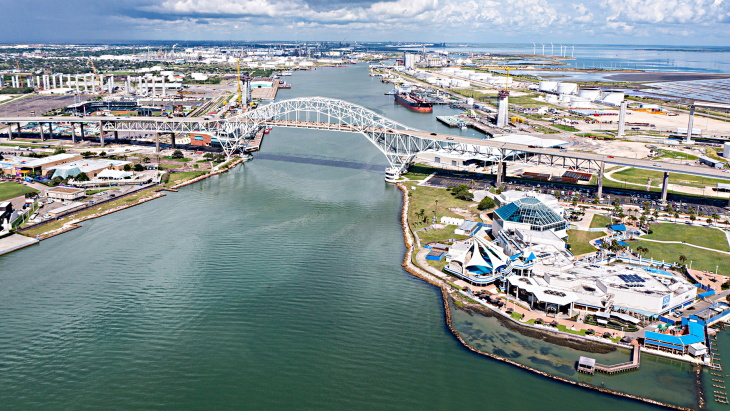
The Port of Corpus Christi - the USA's largest port for petroleum exports - has now also signed a memorandum of cooperation with MARAD to explore the use of nuclear maritime technologies.
Through the memorandum, MARAD and the Port of Corpus Christi have agreed to work together to explore opportunities to advance maritime energy systems, including through the potential integration of SMR technologies, resilient port microgrids, shoreside power architecture, infrastructure capable of supporting emerging vessel propulsion concepts, and related workforce development opportunities.
"Small modular reactors have the potential to reshape America's maritime sector, lower shipping costs, and bolster our supply chains," said US Transportation Secretary Sean Duffy. "I'm thrilled that the Port of Corpus Christi is embracing this exciting partnership with the Trump Administration to ensure the United States leads the way in innovation. Maritime dominance starts with rebuilding America's fleet with this state-of-the-art technology."
Maritime Administrator Stephen Carmel added: "This agreement with the Port of Corpus Christi demonstrates that the leading energy port in the nation understands the significance of this technology. SMR integration has the potential to drive down costs and guarantee that our critical Gulf Coast maritime supply chains remain resilient against any contingency, from extreme weather to power grid disruptions, while training the next generation of high-skilled American mariners."
"With this agreement, the Port of Corpus Christi affirms its commitment to work with the Administration to promote innovation in the US maritime sector in support of our nation's storied maritime industrial base and the communities around the world that depend upon it," said Jeff Pollack, Chief Strategy and Innovation Officer for the Port of Corpus Christi.
Core Power study
Meanwhile, the Port of Corpus Christi has signed a memorandum of collaboration with UK-based maritime nuclear energy specialist Core Power to study opportunities for firm, reliable power from floating nuclear power plants (FNPPs) and readiness for future calls by nuclear-powered commercial ships.
_2182e5c1.jpg)
Rendering of a Core Power 300 MWe FNPP preparing for operations (Image: Core Power)
The partners intend to assess the site-specific technical, environmental, regulatory, operational and commercial requirements for the potential deployment of an FNPP. The work is expected to consider marine and site conditions, water use and discharge, grid connection, potential customer and offtake requirements, candidate locations and mooring, safety and security, permitting, operations, maintenance and long-term service support. They also intend to examine what would be required for the port to receive nuclear-powered commercial ships safely and routinely in the future. The work is expected to consider a reference vessel and power-system envelope, transit and berthing, port-stay safety and security, cargo interfaces, emergency preparedness, liability, classification and the roles of US and international maritime and nuclear authorities.
"The Port of Corpus Christi provides an opportunity to assess both pathways separately while understanding the shared infrastructure, safety, regulatory and commercial questions around them, Core Power said. It added: "The proposed study is a preliminary, fact-finding exercise. It does not select a site, reactor technology or vendor; initiate licensing or permitting; commit investment; approve construction; or authorise the deployment of an FNPP or calls by nuclear-powered commercial ships."
"Port Corpus Christi, as the preeminent energy gateway in North America, is committed to remaining a leader in the global energy marketplace, even as that marketplace expands and evolves," Pollack said. "This collaboration will help us understand what would be required technically, environmentally, operationally and commercially for floating nuclear power plants and future calls by nuclear-powered commercial ships to be considered in the real-world context of the Port. It is about gathering evidence and keeping our region competitive for future investment, industry, and high-value jobs."
Core Power noted the agreement signed between the Port of Corpus Christi and MARAD, saying: "Taken together, these separate but complementary agreements represent an important step toward translating maritime nuclear technology into practical readiness requirements for US ports."
"Ports are where energy systems and global trade meet," said Core Power CEO Mikal Bøe. "For floating nuclear power plants, we need to understand sites, grids, customers, operating models and long-term service arrangements. For nuclear-powered commercial ships, we need safe and predictable pathways for transit, berthing and routine port operations. Port Corpus Christi gives us a real operating environment in which to assess both pathways separately, but as parts of the complete industrial and regulatory system needed to make maritime nuclear commercially deployable. This is how we move from promising technology to products and infrastructure capable of supporting US energy and maritime competitiveness."


_51287.jpg)
_42437.jpg)